

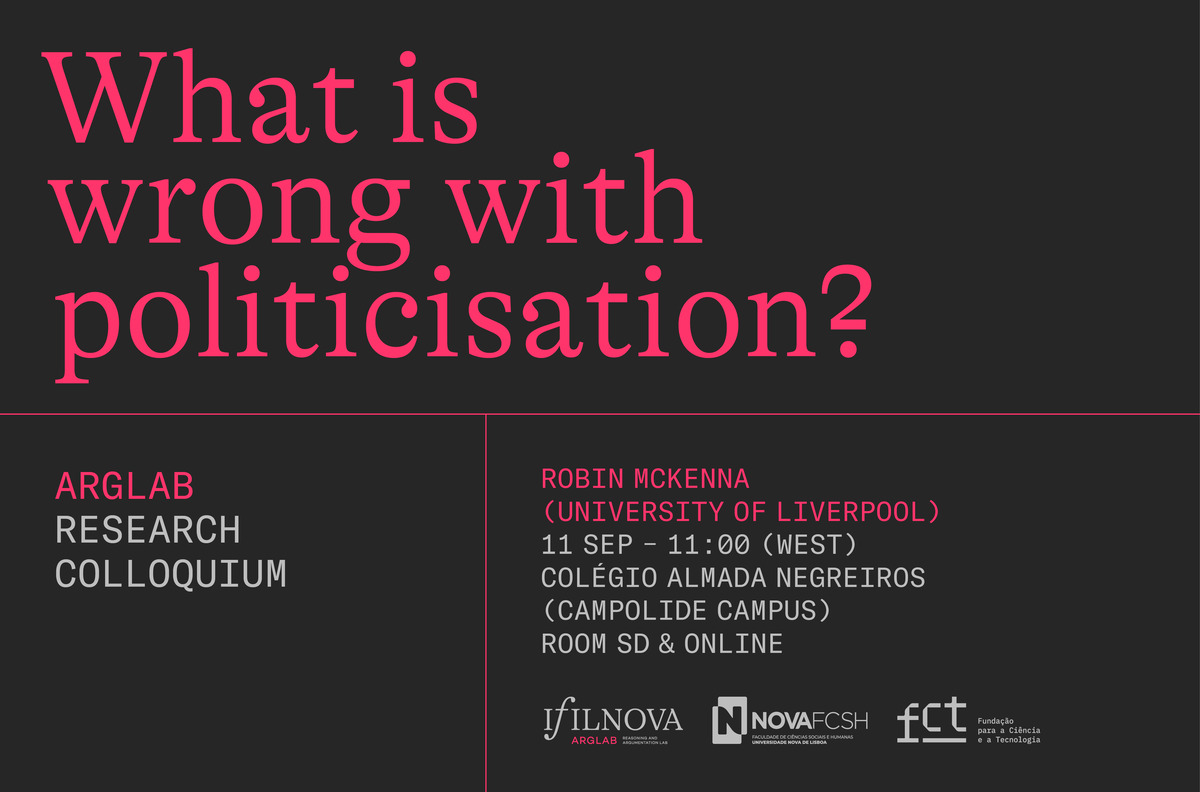
Robin McKenna on “What is wrong with politicisation?”
There has been a lot of discussion, both in public discourse and in the academic literature, about the “crisis of knowledge” and the “age of distrust”. Knowledge, and the institutions and people that produce it, have become embroiled in pitched political battles and debates, as seen during the Covid pandemic, debates about the ideological skew of the social sciences and humanities, and the like. This paper starts from the premise that the “crisis of knowledge” is, in large part, a crisis of politicisation. This paper then addresses two questions: what is politicisation, and when is it a problem? I answer the first question by motivating a minimal definition of politicisation, on which the politicisation of something (an issue, an institution, an act) is a matter of transporting it into the political sphere. We need a minimal definition because, otherwise, we will smuggle in a particular conception of the political, which will skew our understanding of politicisation, and prejudge the question of when politicisation becomes problematic. I address the second question by considering two concrete accounts of politicisation, one that ties it to a deliberative understanding of politics, and one that ties it to a republican understanding of politics. While both accounts have their uses, I give some reasons for thinking why the deliberative democratic account provides an incomplete diagnosis of what is driving phenomena like politicisation and polarisation. In particular, it lacks the tools for thinking about political problems that are the result of an inability to turn the results of political deliberation into political action. I suggest that a republican understanding of politics and politicisation promises to do better here, because it foregrounds direct political action. I finish by sketching an account of when direct political action is likely to be productive, and when it is likely to be destructive.
Robin McKenna (University of Liverpool)
To join the session on Teams, please get in touch with Giulia Terzian (giuliaterzian@fcsh.unl.pt) and Maria Grazia Rossi (mgrazia.rossi@fcsh.unl.pt).
This event is part of the ArgLab Research Colloquium organised by Maria Grazia Rossi, Giulia Terzian and Alberto Oya at the Laboratory of Argumentation, Cognition and Language of the NOVA Institute of Philosophy. For any inquiries, please contact Maria Grazia, Giulia or Alberto.