

Old wine in new barrels? The tribunate as a democratic innovation
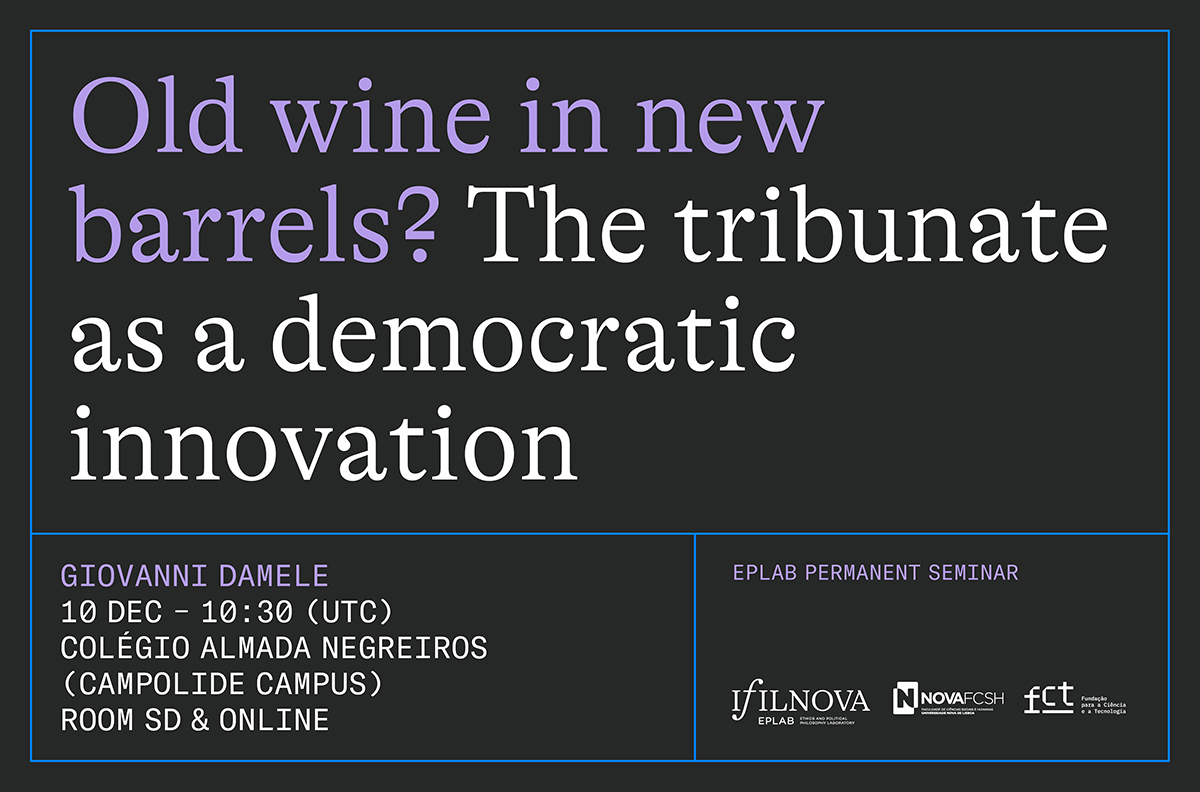
The 16th session of the EPLab Permanent Seminar will be led by Giovanni Damele (IFILNOVA), who will talk about “Old wine in new barrels? The tribunate as a democratic innovation”. The session will take place on 10 December, at 10:30, in room SD at Colégio Almada Negreiros (Campolide Campus), with online transmission, and will be held in English.
Anyone interested in attending, either in person or online, should contact the organisers: Inês Pinheiro (ines.pinheiro@campus.fcsh.unl.pt) and Devon Cass (devoncass@fcsh.unl.pt).
Abstract
In recent years, there has been a resurgence of interest in the Roman magistracy of the “tribunate of the plebs” as a “class-specific political institution” (Harting, 2023) and as proposal for institutional reform in response to the crisis facing contemporary democracies (Vergara, 2020; Arlen & Rossi, 2022; Westphal & Prinz, 2024). It has been argued that the class-based nature of this magistracy would serve both to restore democratic power to non- elite and to curb the dominance of economic and financial oligarchy, halting the systemic decay of liberal democracies into oligarchic plutocracies. Ultimately, the political action of this magistracy could make a decisive contribution to reducing the deep economic inequalities that underpin the corruption of any democratic regime. It should also be noted that this revival draws mainly on Niccolò Machiavelli’s interpretation of the tribune’s magistracy, based on his reading of Livy, and on its recent reinterpretation proposed by John P. McCormick (McCormick 2011; see also Smith & Owen, 2011). We therefore have, at this point, a threefold framework: the tribunate as narrated by Livy, interpreted by Machiavelli, and in turn reinterpreted by McCormick. For a reference to a historically attested institution to have any theoretical significance, it is necessary, first and foremost, to verify the plausibility of the historical reconstruction itself. That is to say, whether the reference to the Roman tribunate truly points to a viable path for modern democracies. In this case, moreover, reference must also be made to the Machiavellian interpretation, which constitutes the main point of reference for almost all authors who have sought to revive, in a radical-democratic fashion, the tribunate. In this article, we shall attempt to offer a critical analysis of the recent debate on the tribunate from three perspectives: that of historical reconstruction, that of the reading of Machiavelli’s interpretation and, finally, that of its plausibility as a democratic innovation.
REFERENCES
Arlen, Gordon, & Rossi, Enzo (2021). “Must Realists Be Pessimists About Democracy? Responding to Epistemic and Oligarchic Challenges.” Moral Philosophy and Politics, 7(2), 241–268.
Harting, Vincent (2023). “An Egalitarian Case for Class-specific Political Institutions.” Political Theory, 51(5), 843-868.
McCormick, John P. (2011). Machiavellian Democracy. Cambridge University Press.
Smith, Graham, and David Owen (2011). “Machiavellian Democratic Innovations: McCormick’s People’s Tribunate.” The Good Society, 20(2), 203–215.
Vergara, Camila (2020). Systemic Corruption: Constitutional Ideas for an Anti-Oligarchic Republic. Princeton University Press.
Westphal, Manon, & Prinz, Janosch (2024). “The Tribunate as a Realist Democratic Innovation.” Political Theory, 52(1), 125–151.
More information on the EPLab Permanent Seminar here.