

28/01/2026
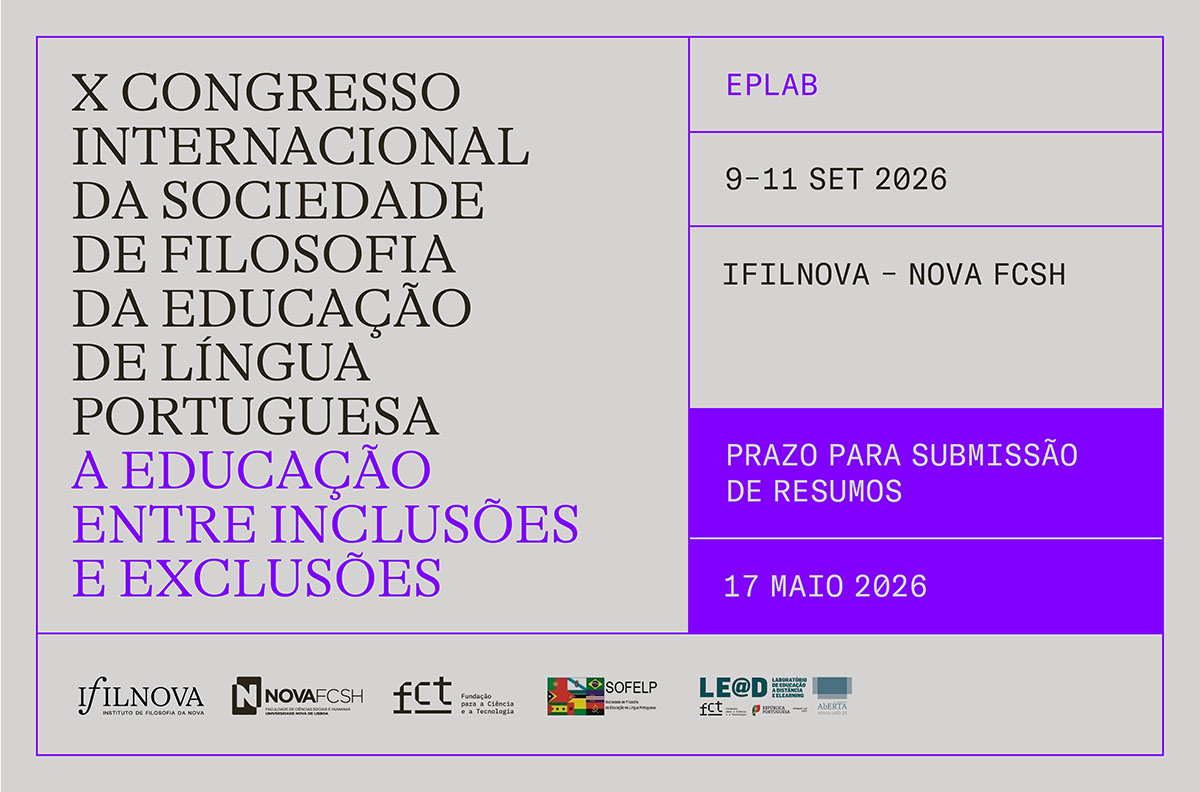
Dates: 9, 10 and 11 September 2026
Host institution: IFILNOVA – NOVA FCSH (PT)
Venue: Faculdade de Ciências Sociais e Humanas da Universidade NOVA de Lisboa – Lisboa-PT
Background
The Portuguese-Speaking Society for Philosophy of Education – SOFELP was established in 2008 with the aim of: a) developing activities within the scope of its scientific mission; b) promoting and advancing research in its academic fields; c) providing consultancy and other specialised services to public and private entities; d) organising congresses, colloquia, seminars, and other related activities; e) disseminating texts, seminars and other research outputs; f) collaborating with national and international, public and private entities in the realization of studies, projects, and activities, as well as in the promotion of research centres.
SOFELP has organised 9 international Congresses and 5 international Colloquia in different countries of the Lusophone community. Within the philosophical tradition, at its margins or at the intersection with other fields of knowledge, congresses and colloquia have addressed emergent themes and theoretical-practical contributions, fostering spaces for debate between education and multi-perspectival conceptions drawn from ethics, politics, epistemology, technique, aesthetics, ontology, religion, anthropology, gender, and pedagogical practice. Instigated by the critical and comprehensive nature of a Philosophy that reflects on Education in existence and life itself, this breadth of knowledge and perspectives has been a distinctive hallmark of SOFELP, across all latitudes and longitudes of the Portuguese-speaking world.
In 2026, in association with IFILNOVA, Instituto de Filosofia da Universidade Nova de Lisboa, and the Distance Education and eLearning Laboratory of the Universidade Aberta – LE@D, its X International Congress is dedicated to the following theme: Education at the Crossroads of Inclusion and Exclusion. It thus aims to promote a broad reflection on one of the areas that underpins educational reality and assumes particular relevance in the contemporary context.
Rationale
In every era and society, diverse processes of inclusion and exclusion mark what appears as education. The multiple and varied purposes that have been attributed to it result in statements that recognize this dialectic between what is included – by right, necessity, or conviction – and what, consequently, should be excluded, for the same reasons: initiation into adult live, privilege for the citizen, for the sir, for the leader, condition of the cultural elite, pathway to labor or economic success, selection of the most capable, guarantee of leisure, opportunities for personality formation, self-care and care for others, the quintessential way to promote social integration, acculturation, or the achieve an idealized human being. Much of the educational discourse is therefore concerned with the formulation of rationales and validations of these correlations between the two guiding principles, while practices align with such purposes, mostly to realize them, and sometimes to overcome them. This phenomenon means that this dynamic is not static, whether synchronically or diachronically. Instead, it implies a wide range of nuances and variations that are important to identify and understand, relative to the dominant characteristic of each educational conception, more exclusionary or more inclusive. Similarly, discourses that aim to define the meanings of such a movement emerge from different epistemic areas, converging toward a shared understanding on what should be included or excluded, valued or segregated, recognized or rejected, welcomed or disowned.
In a context of a multifaceted and asymmetrical reality regarding social, political, economic, and cultural conditions, in general, and educational systems in particular, in which, despite all efforts, forms of exclusion increase, a future of greater equality, respect for diversity, greater democracy despite the plurality of circumstances, and greater solidarity, regardless of the solutions found, has been envisioned. In this perspective, the intention to establish the decisive predominance of the inclusive factor over forms of exclusion reveals a potential historical difference. In such a vision of a future already inscribed in the present will, the Enlightenment and humanist model of the education for all that best aligns with democratic ideals should become an inclusive education for all. Despite the increasingly widespread dissemination of this discursive orientation, new forms of exclusion, or reconfigurations of existing ones, arise, either because of conditions defined by this discourse or as unintended consequences. One of the most prominent issues today is related to the use of digital technologies, particularly applications within the scope of Generative Artificial Intelligence. When used responsibly, and regulated with transparency and fairness, such technologies can promote inclusion by facilitating services, personalizing learning, and expanding civic participation. However, their unregulated application can exacerbate exclusion due to inequalities in access, literacy, and data biases. At the same time, the entire set of issues surrounding the movement of people, multiculturalism, and local integration constitutes another domain of inclusion and exclusion that directly affects educational thought and practice. This polarity thus embeds a regime of profound tensions within contemporary thought and action, highlighting the need for an in-depth discussion of what the concept of education and educational practices encompasses, in order to fully realize such normative directives and to understand the persistence of multiple exclusionary processes that undermine or obstruct it.
The X SOFELP International Congress, in partnership with IFILNOVA and the Distance Education and eLearning Laboratory of the Universidade Aberta – LE@D, dedicated to the theme: Education at the Crossroads of Inclusion and Exclusion, precisely acknowledges the importance of this debate regarding the notional framework that validates the project of an inclusive educational matrix, the conditions for its implementation, the limitations it faces, the dissenting alternatives that arise, and how it intertwines with forms of exclusion. It also acknowledges that the problem falls within the scope of the Philosophy of Education, instigating a complex reflection on the educational phenomenon through these two values, which should contribute to a clearer understanding of what is at stake. Finally, it acknowledges that such a dialectic can only become evident by the previous identification of the plurality of its expressions and through pluridisciplinar dialogue, particularly among the fields of knowledge that take education as their epistemological object.
Thematic areas
The discussion of the theme of this event will be approached by an interdisciplinary perspective, based on the dialogue between the Philosophy of Education and other fields of knowledge. The program consists of:
- Three plenary lectures, one in the area of Philosophy of Education, another in Educational Studies, and a third addressing the emerging issues of Artificial Intelligence and its impacts on educational processes.
- Three roundtables, aiming to promote dialogue between the Philosophy of Education and other disciplines of Educational Studies (Sociology of Education, History of Education, Psychology of Education, Economy of Education, Politics of Education, Art Education), around the question: how has contemporary education been promoting inclusion or inducing exclusion?
- Oral presentations, posters, presentations of research projects in the field of Philosophy of Education, SOFELP intervention area, or in other research fields that engage with it, taking into account different contexts and time periods, on the following topics:
1. Inclusive and Exclusive Philosophies of education
2. Education universalities, localities, and institutionalities: concepts and practices
3. The assignment of notions and the order of discourses
4. The effects of the development of the digital technologies
5. Cosmopolitanisms and nationalisms
6. Plural identities: humanisms and post-humanism
Organising Committee
Luís Manuel Bernardo (FCSH/UNL, IFILNOVA) – SOFELP Director
Antonio Joaquim Severino (UNINOVE) – SOFELP Vice-director
José Pedro Fernandes (Escola Superior de Educação BEJA/PT, CIEQV) – SOFELP treasurer
Maria Dulcinea da Silva Loureiro (URCA) – SOFELP secretary
Maria Teresa Santos (UEVORA, CIDEHUS) – SOFELP secretary
Raquel Pereira Henriques (FCSH/UNL, IHC)
Susana Batista (FCSH/UNL, CICS NOVA)
António Moreira Teixeira (Universidade Aberta, LE@D)
João Paz (Universidade Aberta, LE@D)
Cecília Tomás (LE@D)
Scientific Committee
Alípio Dias Casali (PUC São Paulo)
Alessandro Mariani (Università degli Studi di Firenze)
Annalisa Caputo (Università degli Studi di Bari Aldo Moro)
António Cipriano Gonçalves (Universidade São Tomás de Moçambique)
António Gomes Ferreira (Universidade de Coimbra)
Camille Roelens (Université Claude Bernard Lyon 1)
Carla Vilhena (Universidade do Algarve)
Cleide Rita Silverio de Almeida (Universidade Nove de Julho)
Daniel Bart (Université de Toulouse Jean Jaurès)
Daniel Domínguez Figaredo (UNED)
Dulcinea Loureiro (URCA)
Elaine Terezinha Dal Mas Dias (Universidade Nove de Julho)
Elvis Rezende Messias (Instituto Federal do Triângulo Mineiro)
Filipa Seabra (Universidade Aberta)
Gonçalo Marcelo (Universidade de Coimbra)
Isabel Baptista (Universidade Católica Portuguesa)
João Paz (Universidade Aberta)
José Francisco Álvarez (UNED)
José Pedro Fernandes (IPBeja)
Leonor Lima Torres (Universidade do Minho)
Luís Manuel Bernardo (Universidade NOVA de Lisboa)
Luís Miguel de Carvalho (Universidade de Lisboa)
Marcos Antonio Lorieri (Universidade Nove de Julho)
Maria García Amilburu (UNED)
Maria João Couto (Universidade do Porto)
Nadja Hermann (Universidade Federal de Santa Maria)
Paula Cristina Pereira (Universidade do Porto)
Teresa Lopo (Universidade Lusófona)
Timeline
Abstract and keywords submission: 17 May 2026.
Confirmation of acceptance of the submitted abstracts: 21 June 2026.
Full paper submission (3000 words): By later request.
Registration
- Professors and Researchers (with a paper): €50.
- Students (with a paper): €20.
- Members of SOFELP with their membership fees up to date, and members of IFILNOVA and LE@D: free of charge.
Please note that registration is compulsory.
Registration Deadlines
- With a paper: until 30 June 2026.
- Without a paper: until 9 September 2026.
Presentation formats
The event offers the possibility to submit proposals for theoretical papers, academic posters, and ongoing or completed research. Submissions will be accepted in Portuguese, English, French, and Spanish. Oral presentations will have a maximum duration of 20 minutes. In the other formats, presentations should not exceed 10 minutes.
Guidelines for Abstract Submission
ABSTRACT
The text should be between 200 and 300 words and submitted in Word format (doc), with single spacing, Times New Roman font, size 12.
- It should include three to five keywords and be preceded by: the title in bold and centered; the proposed thematic area; the name of the author and co-authors, their affiliations, and email addresses, all aligned to the right and in italics.
- The abstract should address the goals, rationale, and relevance of the discussion presented, as well as its pertinence to the event’s theme.
- Below the abstract and keywords, the author must list the five main bibliographical references used in the work.
- The file should be sent to the following email address: congressosofelp@fcsh.unl.pt.
Authors are requested, when saving the Word document, to name the file with the title of the work, the number of the relevant thematic area (e.g., 1. Inclusive and Exclusive Philosophies of education), and the participation format, either in-person or online.
*Please note: Failure to comply with the above guidelines will result in automatic rejection of the submitted abstract.
FULL PAPER
Guidelines regarding the preparation and submission of the full paper will be provided after the list of accepted abstracts is released.
GENERAL EVALUATION PROCEDURE
All submitted abstracts will initially be reviewed for format compliance. This preliminary evaluation is conducted by the Event Organizing Committee. Abstracts that meet the established formal criteria (abstract word limits, formatting rules) will then proceed to academic merit evaluation by the Scientific Committee.
Evaluation will follow these criteria:
- Relevance, pertinence, and timeliness of the work for the field;
- Conceptual accuracy and richness in addressing the topic;
- Consistency and rigor in the theoretical-methodological approach and argumentation;
- Originality and contribution to advancing knowledge in the field;
- Clear and correct writing in accordance with the standards.
Please note that accreditation of the event as a Continuous Professional Development (CPD) activity has been requested.
Event supported by the Foundation for Science and Technology (Fundação para a Ciência e para a Tecnologia) of the Portuguese Ministry of Education and Science under the project UID/00183/2025.