

Rule consequentialism, future generations and time discount rates
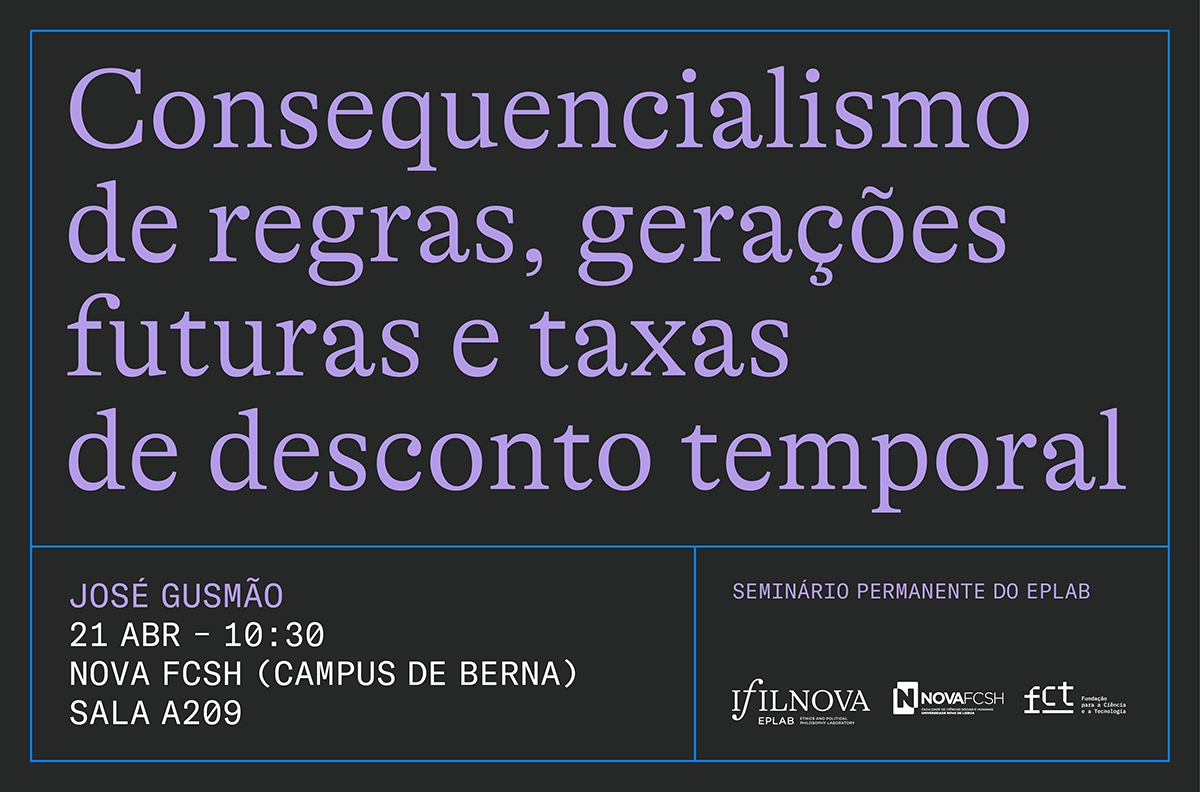
The seventh session of the EPLab Permanent Seminar will be led by José Gusmão (IFILNOVA), who will talk about “Rule consequentialism, future generations and time discount rates”. The session will take place on 21 April, at 10:30, in room A209 at NOVA FCSH (Berna Campus), and will be held in Portuguese.
Abstract
Consequentialism is often presented as incompatible with temporal discount rates, that is, with the attribution of moral priority to present well-being over future well-being. Frank Ramsey (1928), for example, argues that discounting future well-being is unjustifiable and can only be explained by a failure of imagination. I intend to argue that Ramsey is wrong and that there are good consequentialist reasons for accepting temporal discounts. A defensible version of rule consequentialism argues that our fundamental moral obligation is to act in accordance with the system of rules whose general internalisation would produce the best consequences; the moral status of any act depends exclusively on this ideal code. Now, if we do not discount the future, it becomes possible that the ideal code imposes overly demanding duties on us in relation to future generations, which can be equated to forms of servitude in the name of the future. The internalisation of such rules would entail unsustainable psychological and social costs, compromising their acceptance and effectiveness. Therefore, introducing some form of moderate time discounting is not an irrational concession to temporal selfishness, but a necessary condition for a system of rules to be realistically internalised and thus maximise good consequences in the long term.
More information on the EPLab Permanent Seminar here.