

From Eristic to Propaganda – dialogics, belligerence and epistemic communities
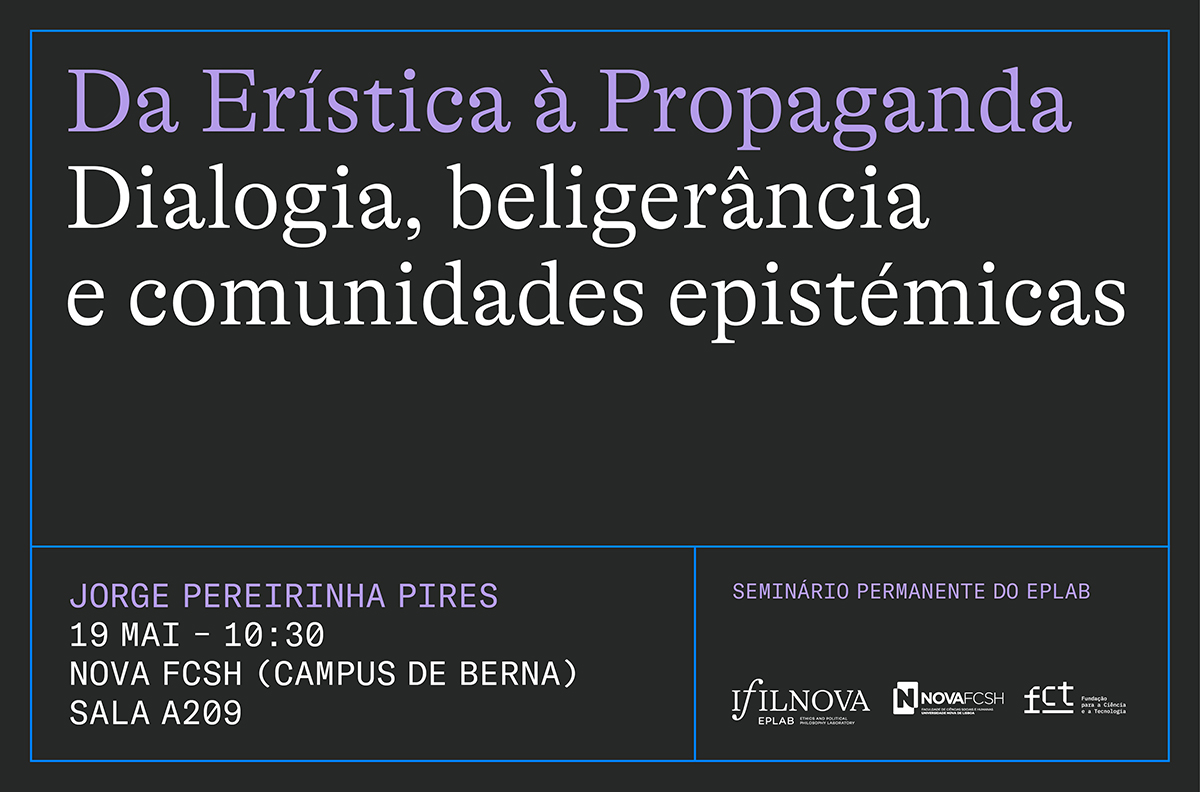
The eighth session of the EPLab Permanent Seminar will be led by Jorge Pereirinha Pires (IFILNOVA), who will talk about “From Eristic to Propaganda – dialogics, belligerence and epistemic communities”. The session will take place on 19 May, at 10:30, in room A209 at NOVA FCSH (Berna Campus), and will be held in Portuguese.
Abstract
Originally conceived to denote the spread of religious faith, the term «propaganda» took on other connotations from the late 19th century onwards, shaped by theoretical and technical developments across various fields of knowledge, and permeating the fabric of societies under a wide range of political systems as a means of shaping and directing the attention and, above all, the behaviour of the masses. Drawing on the analyses of Douglas Walton and Jacques Ellul, this paper offers a brief recapitulation of the notions put forward by these authors, placing particular emphasis on the formal persistence of Eristic – a rhetorical device aimed at preventing or thwarting a conclusive dialogue, which, as a rule, hinders cooperation and fosters belligerence. From this perspective, Paul Virilio’s notion of «pure war» and his observation that propaganda corresponds to a «state of occupation» will serve as an addendum – particularly as the author refers above all to what occurs in liberal democracies, which are today dependent on a mass culture that is necessarily populist and driven by emotions, and thus faced with a moral and political dilemma: How can we live with propaganda? How can we survive without it?
Keywords: Eristic; Propaganda; Jacques Ellul; Douglas Walton; Paul Virilio; Mass culture; Sensus Communis.
More information on the EPLab Permanent Seminar here.