

Rogério Lopes & Aritz Pardina Herrero
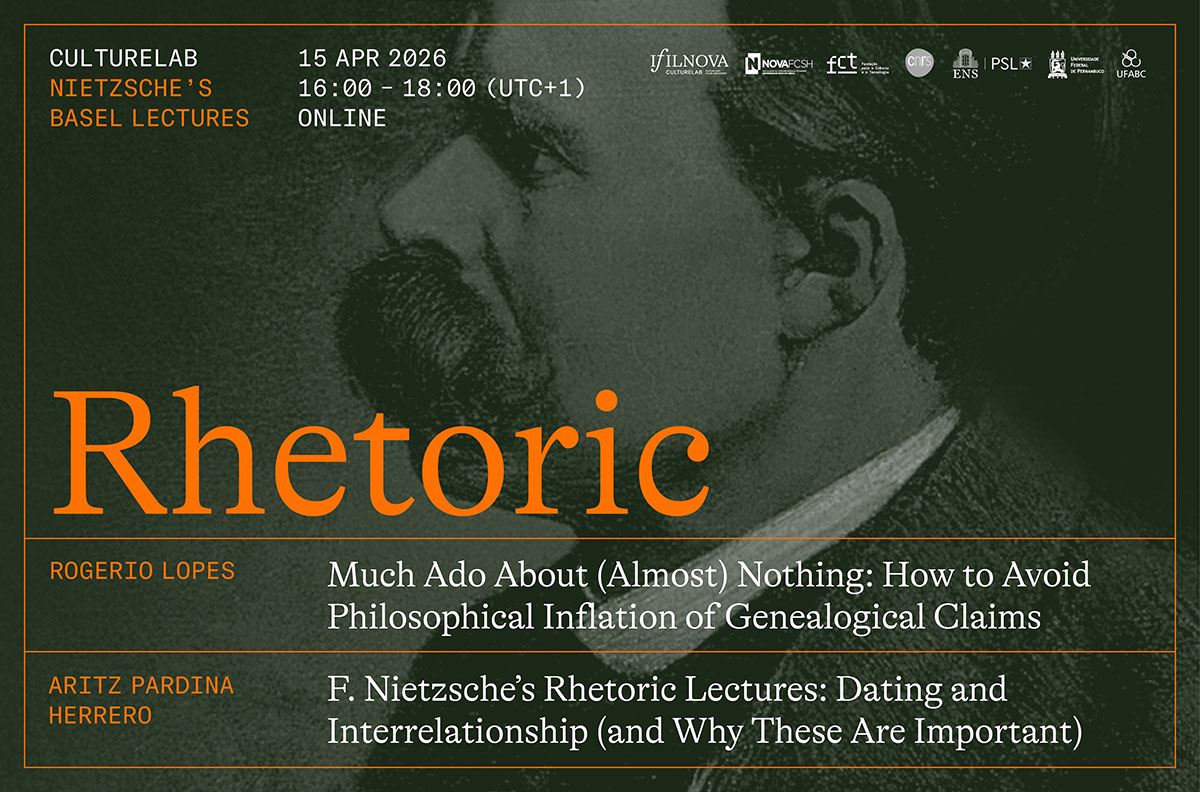
The eighth session of the International Seminar Nietzsche’s Basel Lectures will be dedicated to the theme Rhetoric and will take place online on 15 April 2026 (Wednesday), from 16:00 to 18:00 (UTC+1). The session will be led by Rogério Lopes, with a presentation entitled “Much Ado About (Almost) Nothing: How to Avoid Philosophical Inflation of Genealogical Claims”, and Aritz Pardina Herrero, who will speak on “F. Nietzsche’s Rhetoric Lectures: Dating and Interrelationship (and Why These Are Important)”.
To join the session, please get in touch with Paulo Lima at plima@fcsh.unl.pt for the details.
Much Ado About (Almost) Nothing: How to Avoid Philosophical Inflation of Genealogical Claims
Abstract: In my talk, I argue that Nietzsche is not merely a brilliant stylist but a rhetorically conscious philosopher, and that this consciousness is central to his philosophical project. I begin by examining Nietzsche’s early Basel lecture on ancient rhetoric (Darstellung der Antiken Rhetorik, ca. 1872–1874). Unlike his other philological activities, this lecture received significantly more attention and has a much richer history of reception. In it, Nietzsche diagnoses modernity’s unconscious use of language, introduces the famous claims that language has a tropological structure and a primarily rhetorical function of producing persuasion (claims he extends to perception and conceptualization, mainly in “On Truth and Lies in a Nonmoral Sense”), but also insists on rhetoric as an art that addresses the ear and the body, operating on the pre-conventional, perlocutionary dimension of language. Against a tradition — exemplified by Heidegger and Paul de Man — that either dismisses or restricts the philosophical relevance of Nietzsche’s rhetoric to an epistemology of tropes, I then show how his rhetorical practice integrates with his philosophy across four dimensions: the expressive (style as physiology, connected to the ethical proof of ancient rhetoric), the heuristic (the indiciary, clue-based paradigm, exemplified by anecdotes, etymology, and the like), the argumentative (Nietzsche refuses the monopoly of the Socratic elenchus as the model of philosophical invalidation and replaces it with polemics as a necessary argumentative counterpart to the genealogical method), and the expository (the aphoristic essay incorporates the enthymematic structure of the rhetorical syllogism and demands an active reader). Together, these dimensions demonstrate that Nietzsche’s philosophy does not merely talk about rhetoric but deliberately performs its work through a heterogeneous set of rhetorical devices. A rhetorically conscious philosophy, for Nietzsche, is one in which how one writes and communicates is inseparable from what one thinks.
Bio: Rogério Lopes (1971) is currently Associate Professor at UFMG (Brazil) and a Research Productivity Fellow of CNPq. He has held research positions at TU-Berlin (2005–2007 and 2011, both with DAAD scholarships), Unicamp (2016), Leiden University in the Netherlands (2017–2018), the Universidade Nova de Lisboa (2023–2024) — the latter two with CAPES scholarships — and the Federal University of ABC (2024). His expertise lies in the history of philosophy, with emphasis on nineteenth-century German philosophy, the reception of skepticism in modernity, and the history of moral and political philosophy. His research focuses primarily on Nietzsche, moral philosophy, the diversity of contemporary genealogical programs and their explanatory ambitions as well as normative implications, retributive emotions in ethical and political life, the egalitarian debate within the post-Rawlsian liberal tradition, and contemporary political realism in authors such as Judith Shklar and Bernard Williams. In Nietzsche scholarship, he has published monographs on Nietzsche and Rhetoric (2006) and on Nietzsche and the Skeptical Tradition (2008). As editor, he has organized special issues on topics including Nietzsche and Naturalism (2011), Nietzsche and the Greeks (2012), Nietzsche and the Kantian Tradition (2013), Nietzsche and the History of Moral Philosophy (2016–2017), Nietzsche and Perfectionism (2021–2022), and Nietzsche, Race, and Racism (2025).
F. Nietzsche’s Rhetoric Lectures: Dating and Interrelationship (and Why These Are Important)
Abstract: This talk addresses the ongoing scholarly debate concerning the dating and interrelation of Nietzsche’s rhetorical writings, seeking to clarify issues that are often treated as merely philological. It argues that these problems are in fact philosophically decisive, since the commonly held view that rhetoric precedes On Truth and Lies in an Extramoral Sense remains untenable without a secure chronological account. By distinguishing between manuscript composition and lecture content, the talk tries to shed new light on the development of Nietzsche’s early thought. It further reconceives these writings as a dynamic and stratified textual process shaped by pedagogical contexts. In doing so, it demonstrates that resolving questions of dating and interrelation is essential for a coherent interpretation of Nietzsche’s philosophy of language and truth.
Bio: Aritz Pardina Herrero holds a degree in Philosophy from the University of the Basque Country (EHU). In November 2025, he defended his doctoral thesis on Nietzsche and rhetoric at the National Distance Education University (UNED). His research focuses on the relationship between philology and philosophy in Nietzsche’s work, particularly his early reflections on culture and the question of method. He is a cooperation partner of the INFG in Stuttgart.
About the seminar
It is now widely accepted among experts on Nietzsche’s work that his Basel lectures are essential to a proper understanding of the development of his thinking. Now that the lectures have been published in the critical edition of the complete works, it is necessary to study their sources and the methods used in them, as well as their philological and philosophical content. Despite this, they remain largely unexplored. While some relevant research has emerged, it has focused mainly on specific lectures. There is therefore still a need for research that covers all the lectures, studies them systematically and in their interrelationships, looking for differences and similarities and seeking to determine to what extent decisive aspects of what distinguishes Nietzsche’s thought are already present in them or not. This seminar aims to be a first contribution to filling this gap. It will consist of ten monthly sessions. Each session will focus on one of the series of lectures and its key topic. And it will feature two speakers. The seminar format, with its discussion among all participants after each presentation, is a fruitful model for a project of this kind. Attendance to each seminar session must be preceded by registration through one of the organisers, who will provide the respective link (carlottasantini@hotmail.it, enasser@uol.com.br, plima@fcsh.unl.pt). For more information, see the full seminar programme below.
Org. Carlotta Santini (CNRS/ENS, Paris), Eduardo Nasser (UFPE/UFABC), Paulo Lima (IFILNOVA/NOVA FCSH)
Next sessions
13 May 2026 (Wednesday), 16:00–18:00 (UTC+1)
Sotera Fornaro, “Emotions and Books: Emotions in Friedrich Nietzsche’s Lectures on Literature”
Christian Wollek, “Nietzsche’s lecture on Latin grammar”
17 June 2026 (Wednesday), 16:00–18:00 (UTC+1)
Enrico Müller, “Between Cultic Performance, Symbolic Power, and Aesthetic Achievement: Nietzsche on Attic Tragedy”
Rafael Carrión Arias, “History of Greek Literature from 1874-76: The Origins of Genealogical Method in F. Nietzsche”