

The Film-Phil Lisbon Seminars: Corey Cribb
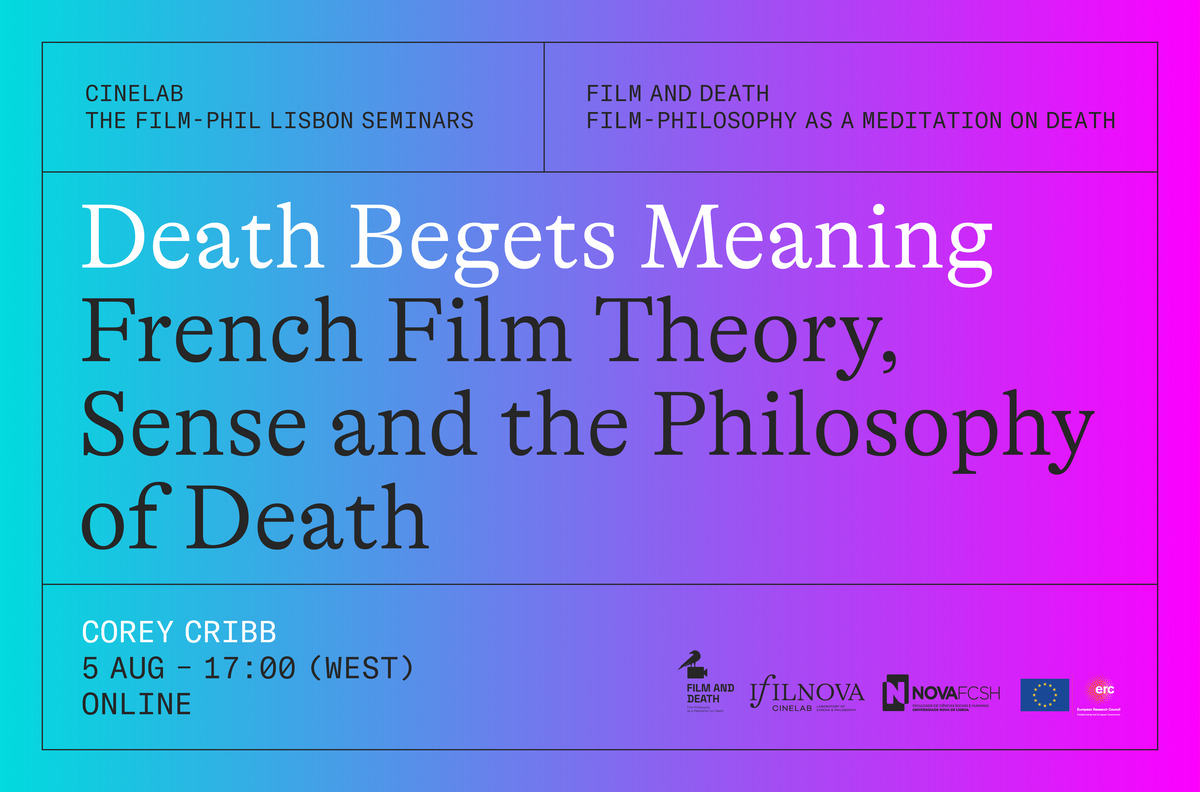
August’s Film-Phil Lisbon Seminar will be led by Corey Cribb (Technological University Dublin) who will talk about “Death Begets Meaning: French Film Theory, Sense and the Philosophy of Death”. This will be an online session and will be held on 5 August 2026, at 17:00 WEST, via Microsoft Teams. Click here for registration.
Abstract
In this talk, I will isolate one of the throughlines of my forthcoming monograph on the question of sense in French film theory and philosophy Film and the Philosophy of Sense. In exploring the way philosophically inflected writings on cinema by Marie-Claire Ropars, Gilles Deleuze, Jean-Luc Nancy and Jacques Rancière rethink the problem of cinematic meaning popularised by structuralist semiology, one argument advanced by my study is that this strain of film-philosophy effectively reprises one of the dominant motifs in French Hegelianism popularised by Alexandre Kojève in his 1934 lecture “L’idée de la mort dans la philosophie de Hegel” [The Idea of Death in the Philosophy of Hegel]: namely, that death begets meaning. In Kojève’s account, Hegel philosophizes a fundamental rapport between death, desire, language and the subtractive power of the ‘Understanding’ which allows the human subject, or “free historical individual”, to name things, act upon them, and reinvent the world to accord with their anthropic desires. Death, in this respect, lies at basis of Hegel’s all-important “ontological category of negativity” and is therefore necessary to explaining how philosophical concepts don’t merely reflect existence but transform it. None of thinkers covered in my book concur with Kojève’s view of meaning as a form of appropriative negativity and yet, as I will argue, in theorizing cinematic meaning they each reserve a place for negativity/death which ensures that it plays integral role in the genesis of sense. My talk will focus in particular on the way Jean-Luc Nancy’s text on Abbas Kiarostami L’Évidence du film [The Evidence of Film] (2001) arguing that, for Nancy, that the Iranian auteur’s films are renewing the very sense of cinema precisely because they imagine a non-appropriative relation to finitude for which death remains present yet undisclosed or ‘uncaptured’ by the moving image. In this respect, I will argue, Kiarostami’s films can be read as a riposte to the Kojèvian conviction that our freedom must be accomplished through the ‘mastery’ of death is not only conceptually erroneous but also a morally dangerous position.
Bio
Corey P. Cribb is a Government of Ireland Postdoctoral Fellow at Technological University Dublin. Contracted by State University of New York Press, his forthcoming monograph, Film and the Philosophy Sense, interrogates French language debates over cinematic meaning from the 1945 to the present with a focus on the philosophical film theories of Maire-Claire Ropars, Gilles Deleuze, Jean-Luc Nancy and Jacques Rancière. Corey’s research on French film theory has been published in Cultural Politics, French Studies Bulletin, Transformations and NECSUS with forthcoming articles in Deleuze and Guattari Studies and New Review of Film and Television slated for publication this year. He is co-editor of a 2024 special issue of Transformations on film theory and philosophical idealism and of the 2025 anthology Far From the Masters: Experimentations in Post-New Wave French Cinema (Index Press).