

The mole inside you: cognitive divergence, first-person authority, and injustices in self-interpretation
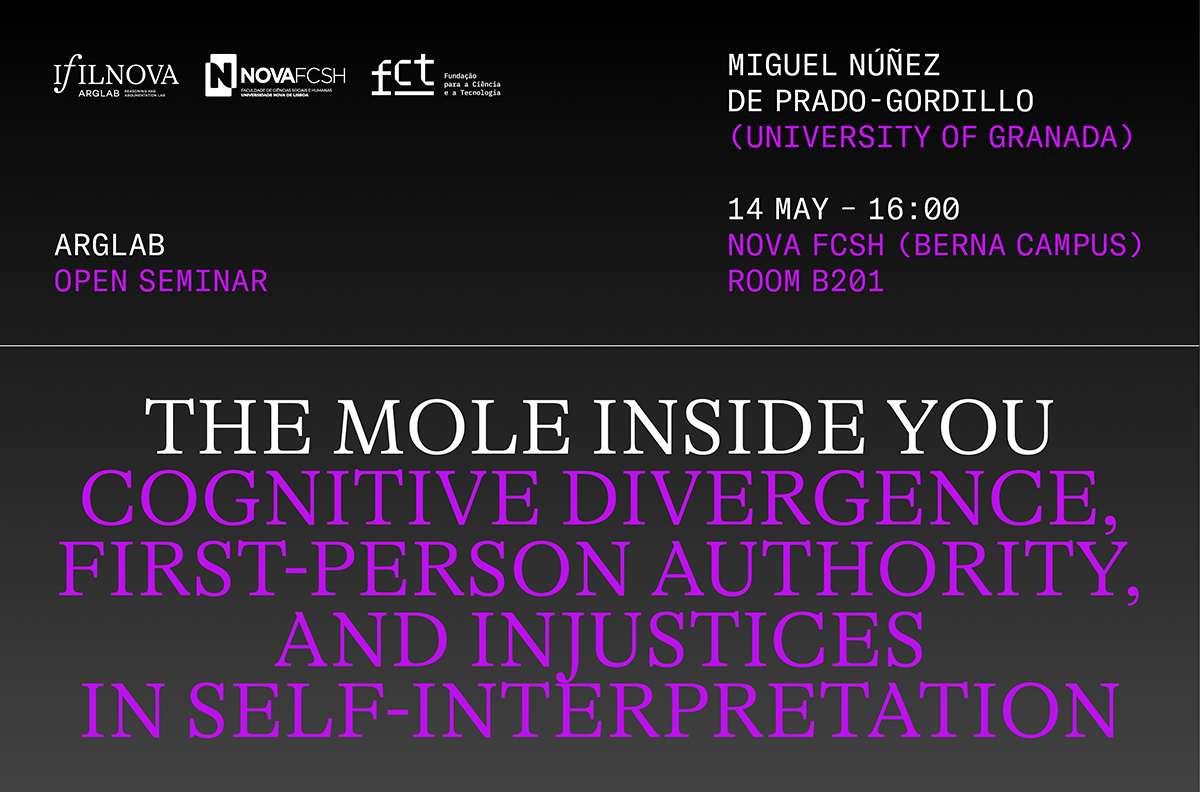
The ArgLab Open Seminar heartily invites everyone to a talk by Miguel Núñez de Prado-Gordillo (University of Granada).
Abstract
The aim of the talk is twofold: first, to develop a self-critical, non-ideal version of mindshaping accounts of mental self-interpretation; and second, to apply this framework to the distinction between impostor and comrade self-interpretations in mental health contexts.
The first part, based on work in progress with Manuel Almagro, critically examines background assumptions about first-person authority (FPA)—the deference granted to individuals’ self-attributions of mental states—that lie at the core of mindshaping approaches to mental interpretation. These emphasize the regulatory, rather than descriptive-predictive, functions of mental-state attributions. Specifically, building on Victoria McGeer’s (1996, 2008) self-regulatory account, mindshaping theorists typically construe FPA as a default social status grounded in agential rather than epistemic privilege: we occupy a privileged position to shape our own minds in line with the social scripts to which our self-ascriptions commit us (Zawidzki, 2016). Despite the theoretical and political merits of this account, we argue that its usual formulation conveys a perniciously idealized conception of mental interpretation, grounded in a dual descriptive-prescriptive idealization: namely, that granting FPA typically is—or should be—the default attitude toward self-ascriptions.
The second part, based on work in progress with Víctor Fernández Castro, illustrates this claim by examining injustices arising within neurodivergent collectives’ struggles to develop counterhegemonic resources for self-interpretation. We analyze two kinds of cases, corresponding respectively to the descriptive and prescriptive dimensions of the idealization just described: (a) Type I cases, involving denials of intelligibility tied to failures to grant FPA; and (b) Type II cases, involving appropriations of neurodiversity and mental health discourse that mask oppressive dynamics, fostered by undue attributions of FPA. We analyze these as forms of hermeneutical injustice involving impostor concepts and narratives (Delgado & Picazo, 2026) in which both pathologizing and trivializing discourses distort the interpretive resources available to neurodivergent individuals, resulting in harmful under- and over-attributions of agency and responsibility (Chapman & Carel, 2022).
How, then, can we distinguish impostors from genuine comrades within an individual’s self-understanding repertoire? And when should we grant FPA to their self-understandings? Building on our preferred, expressivist version of the mindshaping approach (Fernández Castro, 2024), and in line with constructivist views on self-illness ambiguity (Jeppsson, 2022), we argue that drawing this distinction is not a matter of accurately tracking pre-existing boundaries between self and illness. Rather, identifying comrade self-narratives is an evaluative, case-by-case, and open-ended task involving the articulation and negotiation of practical commitments.
This presentation examines the recent career of the term “diversity” as a way of rethinking meaning and, especially, meaninglessness. It begins from a familiar but striking phenomenon: “diversity”, like many buzzwords, can seem at once semantically depleted and yet highly consequential in use, a contrast made especially vivid by the recent shift in its evaluative valence. I argue that this tension arises from a conflation of distinct dimensions of meaning.
References
Chapman, R., & Carel, H. (2022). Neurodiversity, epistemic injustice, and the good human life. Journal of Social Philosophy, josp.12456. https://doi.org/10.1111/josp.12456
Delgado, L., & Picazo, C. (2026). Blocking meaning creation: Impostor concepts and hermeneutical injustice. Synthese, 207(1), 38. https://doi.org/10.1007/s11229-025-05420-w
Fernández Castro, V. (2024). An expressivist approach to folk psychological ascriptions. Philosophical Explorations, 27(1), 86-105. https://doi.org/10.1080/13869795.2023.2251491
Jeppsson, S. (2022). Solving the self-illness ambiguity: The case for construction over discovery. Philosophical Explorations, 25(3), 294-313. https://doi.org/10.1080/13869795.2022.2051589
McGeer, V. (1996). Is «Self-Knowledge» an Empirical Problem? Renegotiating the Space of Philosophical Explanation: Journal of Philosophy, 93(10), 483-515. https://doi.org/10.2307/2940837
McGeer, V. (2008). The Moral Development of First‐Person Authority. European Journal of Philosophy, 16(1), 81-108. https://doi.org/10.1111/j.1468-0378.2007.00266.x
Zawidzki, T. W. (2016). Mindshaping and self-interpretation. En J. Kiverstein (Ed.), The Routledge handbook of philosophy of the social mind (First issued in paperback, pp. 495-513). Routledge, Taylor & Francis Group.
Everybody is welcome!
This seminar series is organised by Pedro Abreu. It gives researchers a platform to discuss work in progress and current problems in philosophy. For administrative inquiries, please contact pedroabreu@fcsh.unl.pt.