

The illusion of impersonality in Hayek’s political philosophy
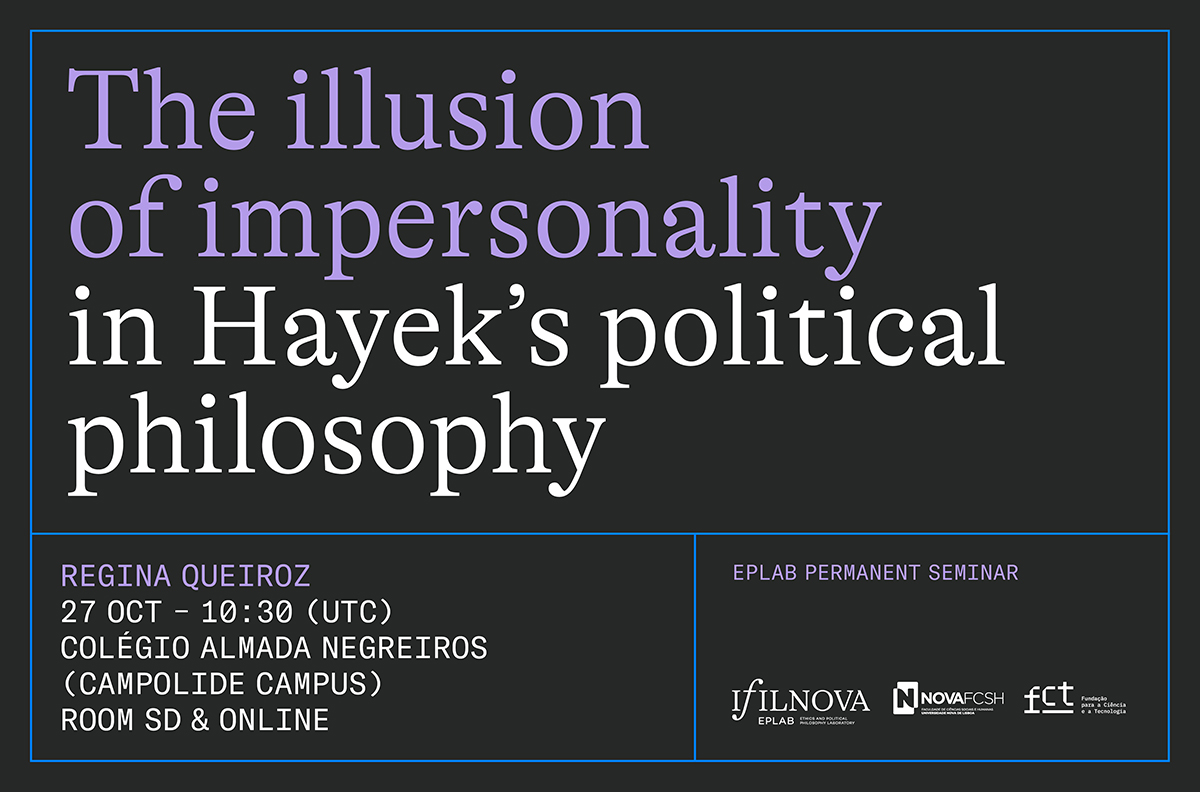
The 13th session of the EPLab Permanent Seminar will be led by Regina Queiroz (Universidade Lusófona), who will talk about “The illusion of impersonality in Hayek’s political philosophy”. The session will take place on 27 October, at 10:30 (UTC), in room SD at Colégio Almada Negreiros (Campolide Campus), with online transmission, and will be held in English.
Anyone interested in attending, either in person or online, should contact the organisers: Inês Pinheiro (ines.pinheiro@campus.fcsh.unl.pt) and Devon Cass (devoncass@fcsh.unl.pt).
Abstract
Hayek argues that when a human society is governed by rational and humane laws that consider the material well-being of its citizens, it cannot avoid arbitrariness, discretionary power, and corruption. Invoking Kantian political philosophy — which rejects such a focus on well-being during the law-making process — Hayek advocates for impersonal laws to ensure equal application of the law and neutrality regarding individual ends.
I argue, however, that unlike Kantian practical philosophy, impersonal laws that neglect material well-being are neither independent of human legislation — notably that of the sovereign people — nor free from discretion. When laws of this kind, often linked to political authoritarianism, shape global public policies, they facilitate discriminatory treatment, undermine liberties (specifically freedom of opinion and political participation), and transform Kantian formal neutrality into a substantive commitment. Ultimately, this process erodes the requirement of impersonality for both authorities and citizens.
Furthermore, this article argues that Hayek’s interpretation fails to grasp how laws can remain independent of the material content of human will — while simultaneously protecting citizens’ well-being — through the fundamental role of freedom of opinion. By highlighting Hayek’s departure from Kantian principles, this article underscores the political importance of impersonality and offers a vigorous defense of individual freedom of opinion and political participation.
Keywords: authoritarianism; impersonality; laws; the people; opinion.
Bio
Regina Queiroz teaches at Universidade Lusófona – Centro Universitário de Lisboa and is a researcher at the Centre for Advanced Studies in Law (CEAD). Additionally, she collaborates with IFILNOVA (NOVA University Lisbon) and the Intrepid Lab (Universidade Lusófona). Her research interests centre on theories of justice — namely Rawlsian theory of justice as fairness and the Aristotelian theory of rationality as phronesis — and on the comparative analysis between liberalism and conservative-libertarianism. She has published articles in international journals, as well as books and book chapters with De Gruyter, Brill, Imprensa Nacional-Casa da Moeda, Almedina, Edições 70, Peter Lang, and Springer. Currently, she is an associate editor for Humanities & Social Sciences Communications (Springer Nature) and serves on the editorial boards of other international journals.
More information on the EPLab Permanent Seminar here.