

Enrico Müller & Rafael Carrión Arias
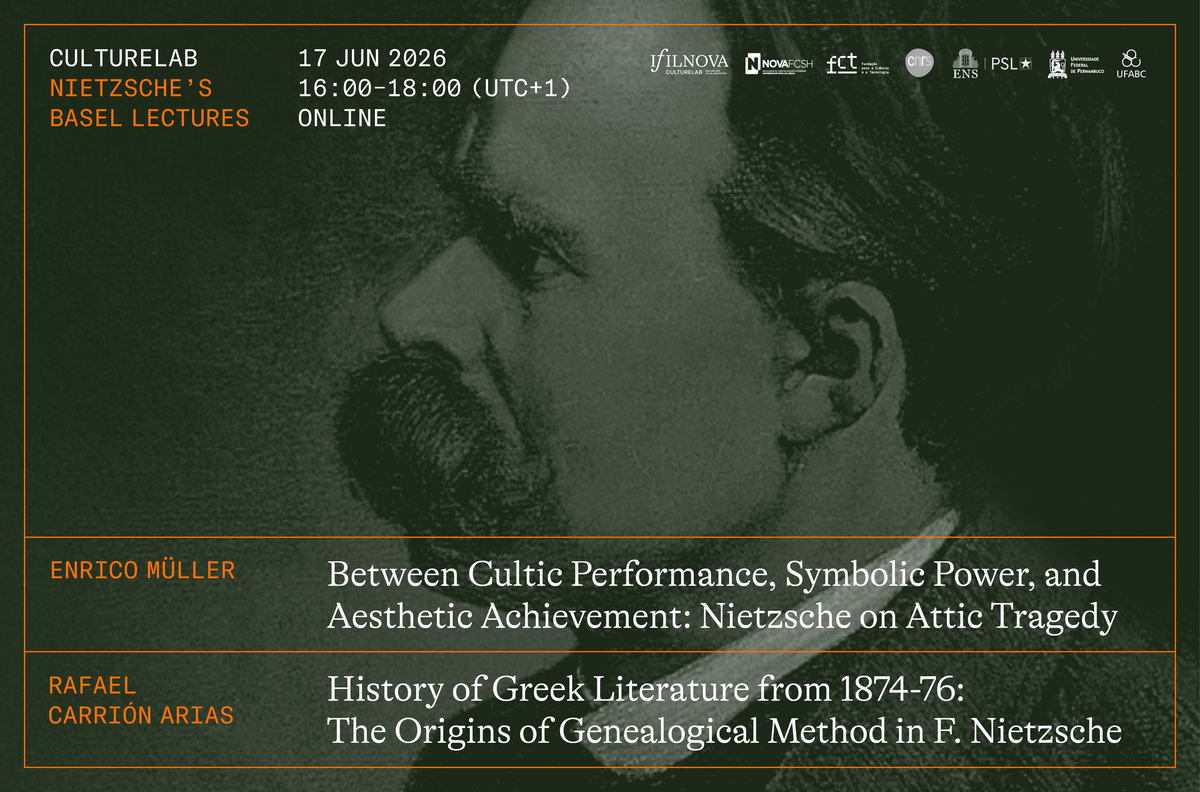
The tenth and final session of the International Seminar Nietzsche’s Basel Lectures will take place online on 17 June 2026 (Wednesday), from 16:00 to 18:00 (UTC+1). The session will be led by Enrico Müller, with a presentation entitled “Between Cultic Performance, Symbolic Power, and Aesthetic Achievement: Nietzsche on Attic Tragedy”, and Rafael Carrión Arias, who will speak on “History of Greek Literature from 1874-76: The Origins of Genealogical Method in F. Nietzsche”.
To join the session, please get in touch with Paulo Lima at plima@fcsh.unl.pt for the details.
Between Cultic Performance, Symbolic Power, and Aesthetic Achievement: Nietzsche on Attic Tragedy
Abstract: Nietzsche’s lectures and readings on Attic drama constitute a central focus of his academic work in Basel. In several respects, they reveal him as an original philologist who was simultaneously, though cautiously, laying the groundwork for his first major work, The Birth of Tragedy. While his courses on Aeschylus largely follow the established hermeneutic practice of close textual commentary, his more systematically conceived lectures on Sophocles are guided by an independent—and strikingly modern—research agenda. Nietzsche’s primary interest lies in the historical practice of performance, the cultic and musical origins of tragedy, and above all in its multimedia character as a Gesamtkunstwerk, a total work of art. In this context, he develops in greater detail his departure both from Aristotle’s influential theory of tragedy and from the idealist philosophical conceptions of the tragic. Pedagogically, Nietzsche presents himself to his students not only as a philologist trained in textual criticism and historical-hermeneutic interpretation, but also as a Sachphilologe—a philologist of material culture—who deliberately draws on historical and archaeological sources in order to reconstruct his object of study, tragedy as a social and performative practice, as concretely as possible.
Bio: Enrico Müller, (Dr. phil.) is currently affiliated with the Research Center for Text Studies at the University of Stuttgart, where he is working on the German Research Foundation (DFG) project “Nietzsche’s Correspondence: Digital Edition and Philosophical Commentary”. Previously, he was Visiting Scholar at the University of Venice (Università Ca’ Foscari di Venezia), Coordinator of a project on the commentary of Nietzsche’s personal library at the University of Freiburg, Research Group Leader at the International Center for Philosophy NRW Bonn (IZPH), Visiting Professor at the University of Campinas (UNICAMP), Visiting Fellow at the German Archaeological Institute (DAI) in Athens and Lecturer and Research Associate at the University of Greifswald. Among his many publications: 2005: Die Griechen im Denken Nietzsches (The Greeks in Nietzsche’s Thought). Berlin/New York: de Gruyter; 2010: (ed., with Friederike Günther), Zur Genealogie des Zivilisationsprozesses. Friedrich Nietzsche und Norbert Elias (On the Genealogy of the Process of Civilization). Berlin/New York: de Gruyter; 2014: (ed., with Christian Benne), Ohnmacht des Subjekts – Macht der Persönlichkeit (The Powerlessness of the Subject – The Power of Personality). Basel: Schwabe; 2018: Nietzsche-Lexikon (Nietzsche Dictionary). Paderborn/Munich: utb Verlag; 2026: Subverted Metaphysics: Plato’s Dialogical Orientation of Philosophy. Nashville: Orientations Press.
History of Greek Literature from 1874-76: The Origins of Genealogical Method in F. Nietzsche
Abstract: In a letter to Malwida von Meysenbug dated September 1877, Nietzsche explained: “I have now finished my studies of Greek literature—who knows what will come of it?” Indeed, Nietzsche’s importance as a historian of literature is as considerable as it is unexpected, especially because in that task all his previous concerns converge in a pivotal way while some of the long-term designs of his mature philosophy are foreshadowed. The present exposition seeks to highlight the role of Nietzsche’s literary historiography based on a work that has not been extensively studied to date by Nietzsche research, namely, History of Greek Literature (1874/1876).
Bio: Rafael Carrión-Arias holds a Ph.D. in Philosophy and a Ph.D. in Literary Theory and Comparative Literature. He has worked on the edition of Nietzsche’s complete works in Spanish and has contributed to the German critical edition of the works of Marx and Engels (MEGA II) and to the Historisch-kritisches Wörterbuch des Marxismus (InKriT). He has been a regular collaborator with the M. Gorky Institute of World Literature at the Russian Academy of Sciences in Moscow. He has taught internationally and has undertaken numerous research stays at prestigious universities and research centers (Stanford University, UCLA, UC Berkeley, University of Cape Town, Taras Shevchenko National University of Kyiv, etc.). He has been a research associate at the Marc-Bloch Centre (Humboldt University of Berlin) and is currently an associate professor at the Complutense University of Madrid (UCM), where he teaches 19th-century philosophy and conducts research on the mature poetry of F. Nietzsche. He has published two monographs: “Batman and the Shadows of Modernity: A Critical Genealogy of the Contemporary Hero in the Age of Nihilism” (Routledge/Taylor & Francis, 2024), in which he has applied the genealogical method to the study of industrial culture, and “History of Greek Literature: The Origins of the Genealogical Method in F. Nietzsche” (Peter Lang, New York, 2020 [in Spanish]).
About the seminar
It is now widely accepted among experts on Nietzsche’s work that his Basel lectures are essential to a proper understanding of the development of his thinking. Now that the lectures have been published in the critical edition of the complete works, it is necessary to study their sources and the methods used in them, as well as their philological and philosophical content. Despite this, they remain largely unexplored. While some relevant research has emerged, it has focused mainly on specific lectures. There is therefore still a need for research that covers all the lectures, studies them systematically and in their interrelationships, looking for differences and similarities and seeking to determine to what extent decisive aspects of what distinguishes Nietzsche’s thought are already present in them or not. This seminar aims to be a first contribution to filling this gap. It will consist of ten monthly sessions. Each session will focus on one of the series of lectures and its key topic. And it will feature two speakers. The seminar format, with its discussion among all participants after each presentation, is a fruitful model for a project of this kind. Attendance to each seminar session must be preceded by registration through one of the organisers, who will provide the respective link (carlottasantini@hotmail.it, enasser@uol.com.br, plima@fcsh.unl.pt). For more information, see the full seminar programme below.
Org. Carlotta Santini (CNRS/ENS, Paris), Eduardo Nasser (UFPE/UFABC), Paulo Lima (IFILNOVA/NOVA FCSH)