

The Film-Phil Lisbon Seminars: Marina Christodoulou
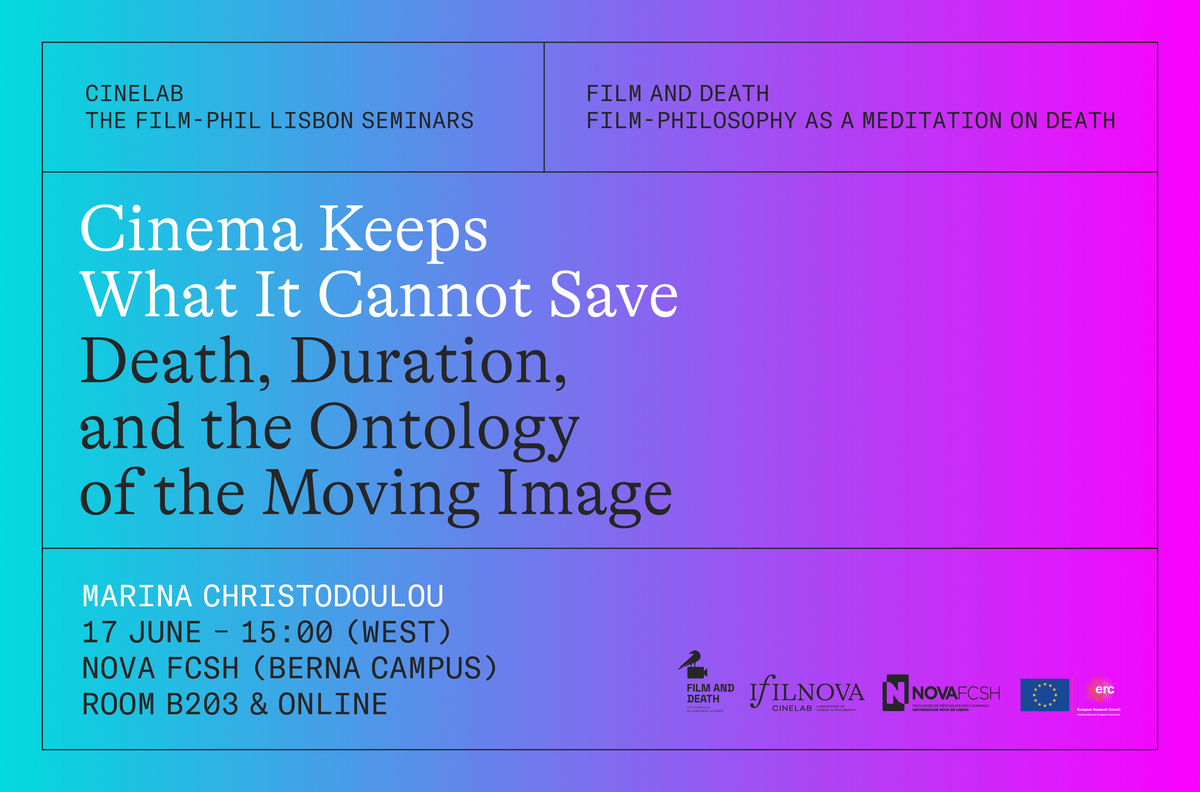
The next Film-Phil Lisbon Seminar will be led by Marina Christodoulou (Constructor (Jacobs) University) who will talk about “Cinema Keeps What It Cannot Save: Death, Duration, and the Ontology of the Moving Image”. This will be a hybrid session and will be held on 17 June 2026, at 15:00 WEST, in room B203 at NOVA FCSH (Berna Campus) and online, via Microsoft Teams. To join the meeting online, please register in advance here.
Abstract
This talk and accompanying essay-film will examine cinema as a medium in which death is not merely represented but formally rehearsed. Beginning with Roland Barthes’s formulation in Camera Lucida that the photographed subject is caught in the paradoxical tense of “being dead and going to die”, the talk asks what happens when this photographic catastrophe begins to move. If the photograph says “this has been”, cinema says: “this has been, and yet it is still happening”. The moving image does not restore life; it converts life into survivable absence, giving the dead not stillness but duration.
Based on readings from Barthes, André Bazin, Walter Benjamin, and Gilles Deleuze, the talk will develop the concept of thanato-aesthetics: the formal and affective logic through which cinema makes finitude visible, repeatable, and sensorially available. Bazin’s “mummy complex” allows cinema to be understood as the embalming not of the instant but of duration; Benjamin’s writings on mechanical reproduction reveals the actor as a technical after-body; and Deleuze’s “time-image” shows how death can appear most forcefully not as event, but as suspended time, (failed) action, waiting, and exhaustion. The long take, actual death footage, genre, and the essay-film are considered as distinct ways in which cinema metabolizes mortality, or as different grammars of death in cinematic genres.
The presentation will also include a screening of my short essay-film, “Zenon is dead, and is going to live”, which functions as both illustration and intervention. Rather than simply accompanying the argument, the film performs it: it stages the paradox of an image that survives its subject while remaining haunted by the life it cannot restore. Both the talk and the film propose that cinema is not a window onto life but a luminous sepulcher, that is, a ritual of return without resurrection. Cinema keeps what it cannot save.
Bio
Marina Christodoulou is a Lecturer in Philosophy at Constructor (Jacobs) University, Bremen and a visiting Lecturer in the Department of Philosophy and in the Gender Centre at the University of Klagenfurt; she has taught in various universities in Cyprus and Germany as a visitor. During 2025 she was also a visiting Nietzsche Fellow at the Klassik Stiftung Weimar. She earned her PhD (Dr. Phil) in Philosophy through a cotutelle between the University of Klagenfurt (Austria) and the University of Toulouse – Jean Jaurès (France), defending her thesis “Life as Addiction” in 2022 with distinction. The dissertation examined addiction as a primary ontological modality rather than a pathology and was recognized with the Prix Georges Bastide of the Académie des Sciences, Inscriptions et Belles-Lettres de Toulouse for the best philosophical work of the year. She has also previously studied Film and Filmmaking (Edinburgh and Athens) and Gender Studies (Klagenfurt and Paris) and holds an MBA in Digital Business Management. She specialized in Ancient and Continental Philosophy both in her bachelor’s degree and in her master’s and to a large degree her Thesis was also inspired by Ancient Philosophy. A central focus of her current research is what she conceptualizes as “ontological exhaustion” or “ontological-existential exhaustion” as the exhaustion or the fatigue of being as being, or the exhaustion of being/living/existing itself, that is, the ontological and phenomenological condition of “being tired of being”. She is editing two volumes for Angelaki: Journal of the Theoretical Humanities (with republication by Routledge) on “Existential-Ontological Exhaustion: Being-Tired, and Tired-of-Being”, as well as two further co-edited volumes on Exhaustion and Body/Illness/Disability, titled “Disabling Experiences and Exhausted Bodies: Disability Illness Embodiment and Existential Experience”, and on Exhaustion in Art/Literature, titled “Expressions of Aesthetic Fatigue: Perspectives on Ontological Exhaustion in the Arts”. Website.