

Film programme Temporality and Decadence
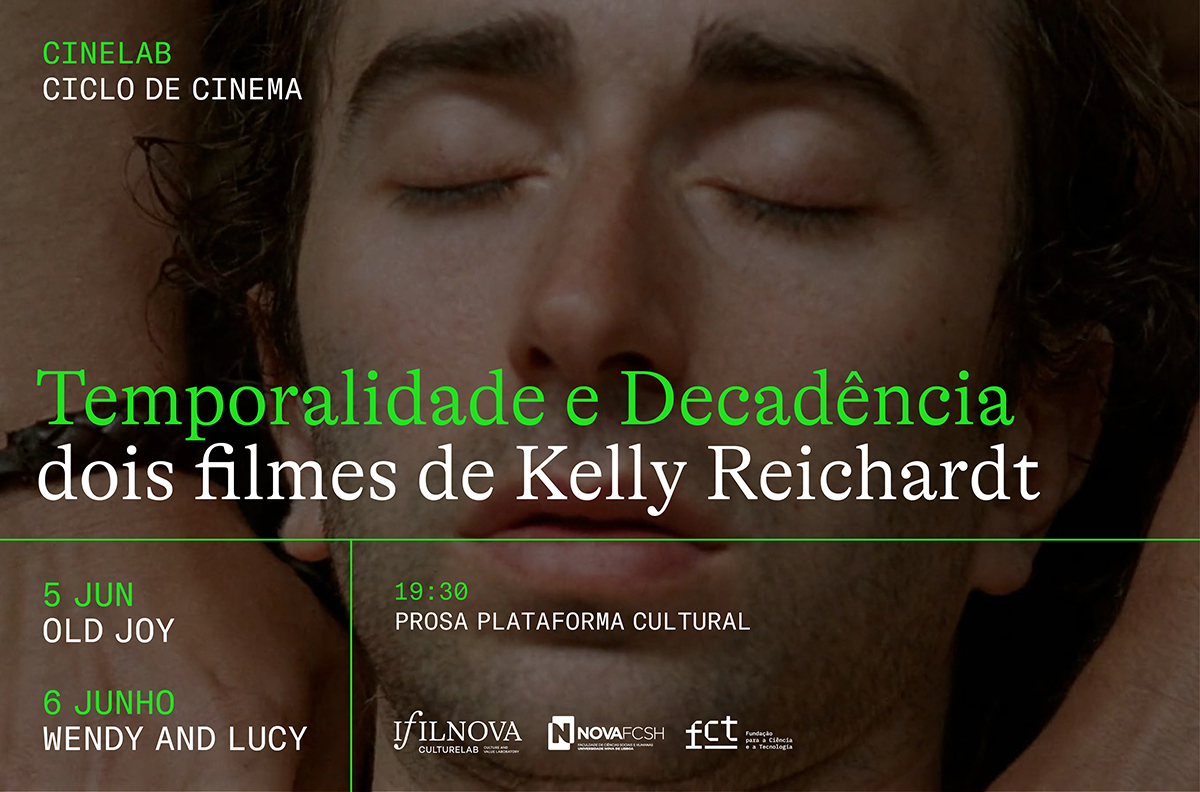
From 5–6 June, PROSA Plataforma Cultural hosts a short film programme dedicated to the American filmmaker Kelly Reichardt, organised by Alexandre Braga and curated by Henrique Brazão, both researchers at CineLab. Entitled “Temporality and Decadence”, the programme brings together two key works in her oeuvre, Old Joy (2006) and Wendy and Lucy (2008), presented across two screenings followed by an open conversation with the organisers and curators of the cycle.
Programme
Friday, 5 June
19:30
PROSA Plataforma Cultural
OLD JOY
2006 | 1h16 [US]
By Kelly Reichardt
Subtitles in Portuguese
Two old pals reunite for a camping trip in Oregon’s Cascade Mountains.
Saturday, 6 June
19:30
PROSA Plataforma Cultural
WENDY AND LUCY
2008 | 1h20 [US]
By Kelly Reichardt
Subtitles in Portuguese
A series of unfortunate happenings triggers a financial crisis for a young woman and she soon finds her life falling apart.
Kelly Reichardt (b. 1964), a leading figure in contemporary American independent cinema, is above all a filmmaker of time. Although her work has been associated by critics and scholars with the rise of “slow cinema” within the international festival circuit during the first decades of the new millennium — a controversial grouping of heterogeneous filmmakers including Pedro Costa, Béla Tarr and Tsai Ming-liang — it is more accurate to define her beyond questions of pacing that emerge inevitably through comparison with other cinematic traditions. Reichardt’s temporalities do not privilege contemplation, nor do they create spaces of respite or counterpoints to the supposed vertigo of an endless flow of images in an inherently accelerated world. Delay, waiting and stagnation arise instead as consequences of the economy of attention her work proposes: a focus on the margins of larger unfolding events, a broad tableau of microscopic interactions between people, animals, and rural or industrial landscapes — recurring motifs throughout her films — remnants of unresolved historical and economic projects.
Based on a short story by Jon Raymond, Old Joy (2006), Reichardt’s second feature after a hiatus of more than a decade, is a study in temporal and narrative economy. A meticulous record of the silent deterioration of a friendship during a retreat to hot springs in Oregon, Old Joy uncovers the extraordinary within banality while gradually constructing ideas of impermanence, always from a sceptical, almost fatalistic perspective. The film’s forms — openly shaped by its production conditions and extremely limited budget, even by independent cinema standards — convey a palpable austerity and remain permeable to the atmosphere of their time. The political climate of anxiety in post-9/11 United States under George W. Bush enters the diegesis through endless radio programmes of political commentary, producing a constant negotiation between the intimate and the large-scale, materialised in hours of waiting, stalled conversations, and a journey without resolution.
In Wendy and Lucy (2008), Reichardt worked again with Raymond on the screenplay, continuing her project of revealing structures in decay, here through the exposure of successive institutional failures in the doomed trajectory of an unprotected woman. Marking the beginning of her collaboration with actress Michelle Williams, the film consolidated Reichardt as a filmmaker of a neo-neorealism, a voice for the updated social concerns of the twenty-first century without the nihilism of mumblecore or the moralism of the quirky indie films abundant in the 2000s. Narrative arcs devoid of any possibility of catharsis, systematic obstacles to the protagonist’s agency, and the institutional weight bearing upon human and animal relationships: through its editing — handled by Reichardt herself — Wendy and Lucy constructs a temporality of apparent stagnation and inevitable decline.
Developed within the project “Cinema and Ecosophy: Values, Econarratives and Deep Ecology”, the programme also highlights a recurring concern throughout Reichardt’s body of work: attention to landscape as a space shaped by human action, economic precarity, and the traces of failed historical projects. Although Night Moves (2013) represents the most explicit formulation of these ecological concerns, in Old Joy and Wendy and Lucy Reichardt already bears witness to forms of erosion inscribed within space itself and within the relationships between humans, animals, and territory. Nature never appears as an idealised refuge or as something external to the social world, but rather as an extension of those very same structures of exhaustion, abandonment, and instability.