

Luca Lupo & Stefano Busellato
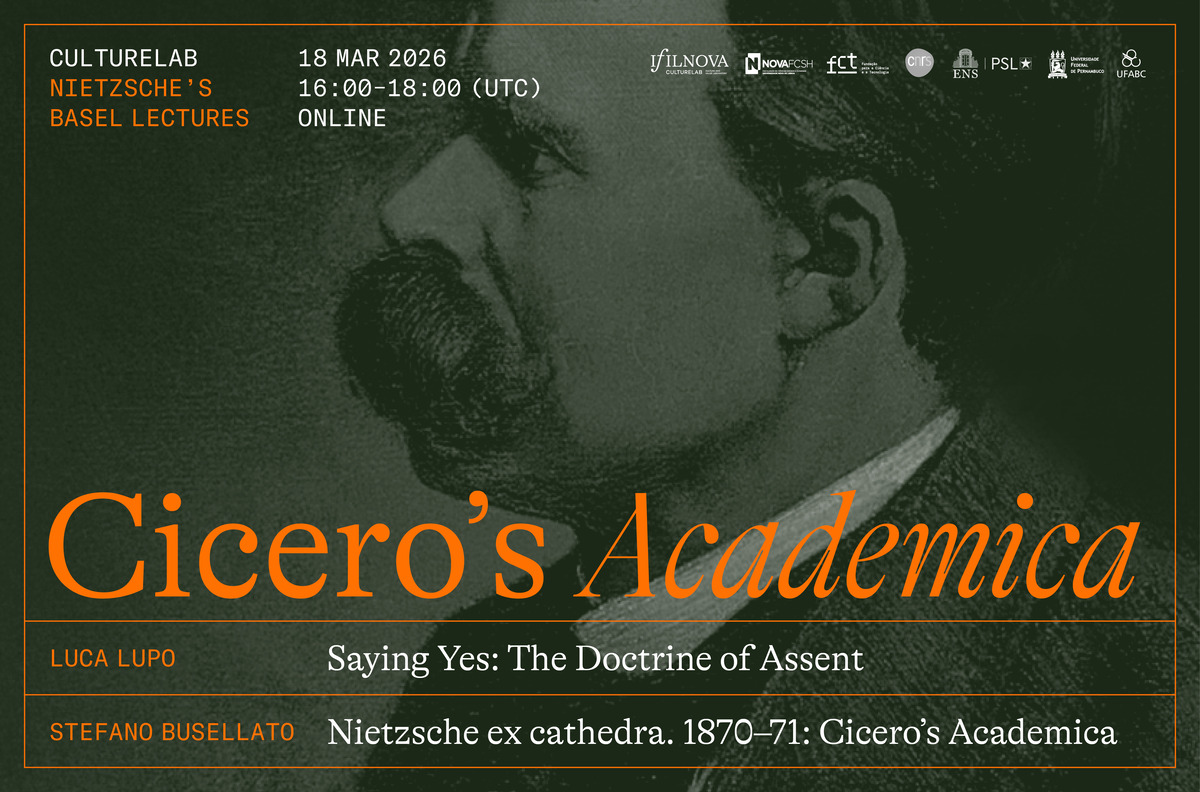
The seventh session of the International Seminar Nietzsche’s Basel Lectures will be dedicated to the theme Cicero’s Academica and will take place online on 18 March 2026 (Wednesday), from 16:00 to 18:00 (UTC). The session will be led by Luca Lupo, with a presentation entitled “Saying Yes: The Doctrine of Assent”, and Stefano Busellato, who will speak on “Nietzsche ex cathedra. 1870–71: Cicero’s Academica”.
To join the session, please get in touch with Paulo Lima at plima@fcsh.unl.pt for the details.
Saying Yes: The Doctrine of Assent
Abstract: Nietzsche’s notes from his time as a philology professor in Basel focus on Cicero’s Academica and stop at the tenth chapter of the second book, the Lucullus. He does not comment on the section dedicated to the doctrine of assent (synkatathesis/adsensio), though some references to that doctrine appear in the Varro.
“Memory can have no existence without assent”, observes Cicero, “no more can notions of things or arts. And what is most important of all is, that, although some things may be in our power, yet they will not be in the power of that man who assents to nothing” (Lucullus, XII, Transl. Yonge 1880). Assent thus functions as a kind of transcendental element underlying the very possibility of perceiving reality—of any object, representation, or judgment: a sort of pre-predicative, perhaps even pre-linguistic, “saying yes” to the real. Hence, it has decisive importance within the economy of Stoic thought.
Much later, when Nietzsche the philosopher is nearing the end of his intellectual path—as seen from the perspective of chronological time, though not from the atemporal psychic and speculative dimension—he defines the Dionysian. He calls it “a formula of the highest affirmation born out of fullness, out of overfullness, an unreserved yea-saying even to suffering, even to guilt, even to everything questionable and strange about existence… This final, most joyful, effusive, high-spirited yes to life is not only the highest insight; it is also the most profound, the most rigorously confirmed and supported by truth and study [Wissenschaft]” (EH, GT 2, Transl. Norman 2005).
Can the Dionysian, as defined, thus be seen as a radicalized anti-skeptical, anti-nihilistic, and, in a certain sense, neo-Stoic development of the doctrine of assent?
Bio: Luca Lupo (Bologna, 1966) is an Associate Professor of Moral Philosophy at the University of Calabria (Italy) — Department of Humanities — where he teaches Ethics, Philosophical Anthropology, and Ethics and Psychoanalysis. His research interests and publications focus mainly on the thought of Friedrich Nietzsche; on the relationship between ethics and psychoanalysis; and on the ethics of scientific research, economic ethics, and environmental ethics. On Nietzsche, he has notably published Le colombe dello scettico, Ets, Pisa 2006, on the problem of consciousness in Nietzsche; Forme ed etica del tempo in Nietzsche (Mimesis, Milan-Udine 2018, for which a Spanish edition was published in 2021 (Formas y ética del tiempo en Nietzsche, Brujas, Cordoba). His most recent publications include the essays “Le Nietzsche volé de Lacan” in Nietzsche et la France, Paolo D’Iorio, Alexandre Avril, David Simonin (Eds.), CNRS Éditions, Paris, 2025 and “Zarathustra dietro il divano. Il superuomo di Freud”, in Alvearium, XVII, December 2024.
Nietzsche ex cathedra. 1870–71: Cicero’s Academica
Abstract: During the summer semester of 1870 and the winter semester of 1870–71, Nietzsche devoted two courses to Cicero’s Academica. These were decisive years in the development of Nietzsche’s thought, which is why the in-depth study of one of the most important documents on the history of ancient scepticism is charged with significance not only from a purely philological point of view but also from a strictly philosophical one. After a general introduction to the subject, some of the most interesting points that emerge from Nietzsche’s study with regard to his theoretical formation and subsequent career will be presented.
Bio: Stefano Busellato, Professor of Philosophy of Language and Philosophy of Literature at UNILA (Foz do Iguaçu, Brazil). Specialist in Nietzschean thought (in which field he is a member of several international research groups) and contemporary aesthetics. He has published monographs on Giordano Bruno, Spinoza, Schopenhauer and Nietzsche, as well as numerous scientific articles in national and international specialist journals. He is the author of three collections of poetry (Tutto è bene quel che finisce, 2004; Chi non muore, 2012, Sujets sous-entendus, 2022, in French and Brazilian Portuguese editions). He is a translator from German, French and Portuguese. He is also a classical baritone and librettist for various operas by composer Francesco Filidei, the latest being Il nome della rosa for La Scala in Milan and the Théâtre de la Bastille. In January this year, he edited the critical edition of Nietzsche’s Lezioni sui Preplatonici for the publisher Vozes.
About the seminar
It is now widely accepted among experts on Nietzsche’s work that his Basel lectures are essential to a proper understanding of the development of his thinking. Now that the lectures have been published in the critical edition of the complete works, it is necessary to study their sources and the methods used in them, as well as their philological and philosophical content. Despite this, they remain largely unexplored. While some relevant research has emerged, it has focused mainly on specific lectures. There is therefore still a need for research that covers all the lectures, studies them systematically and in their interrelationships, looking for differences and similarities and seeking to determine to what extent decisive aspects of what distinguishes Nietzsche’s thought are already present in them or not. This seminar aims to be a first contribution to filling this gap. It will consist of ten monthly sessions. Each session will focus on one of the series of lectures and its key topic. And it will feature two speakers. The seminar format, with its discussion among all participants after each presentation, is a fruitful model for a project of this kind. Attendance to each seminar session must be preceded by registration through one of the organisers, who will provide the respective link (carlottasantini@hotmail.it, enasser@uol.com.br, plima@fcsh.unl.pt). For more information, see the full seminar programme below.
Org. Carlotta Santini (CNRS/ENS, Paris), Eduardo Nasser (UFPE/UFABC), Paulo Lima (IFILNOVA/NOVA FCSH)
Next sessions
15 April 2026 (Wednesday), 16:00–18:00 (UTC+1)
Rogerio Lopes, “Much Ado About (Almost) Nothing: How to Avoid Philosophical Inflation of Genealogical Claims”
Aritz Pardina Herrero, “F. Nietzsche’s Rhetoric Lectures: Dating and Interrelationship (and Why These Are Important)”
13 May 2026 (Wednesday), 16:00–18:00 (UTC+1)
Sotera Fornaro, TBD
Enrico Mueller, TBD
17 June 2026 (Wednesday), 16:00–18:00 (UTC+1)
Gemma Adesso, “The Art of Reading and Writing”
Rafael Carrión Arias, “History of Greek Literature from 1874-76: The Origins of Genealogical Method in F. Nietzsche”