

Nature (physis) and soul (psychē) in Plato’s Republic
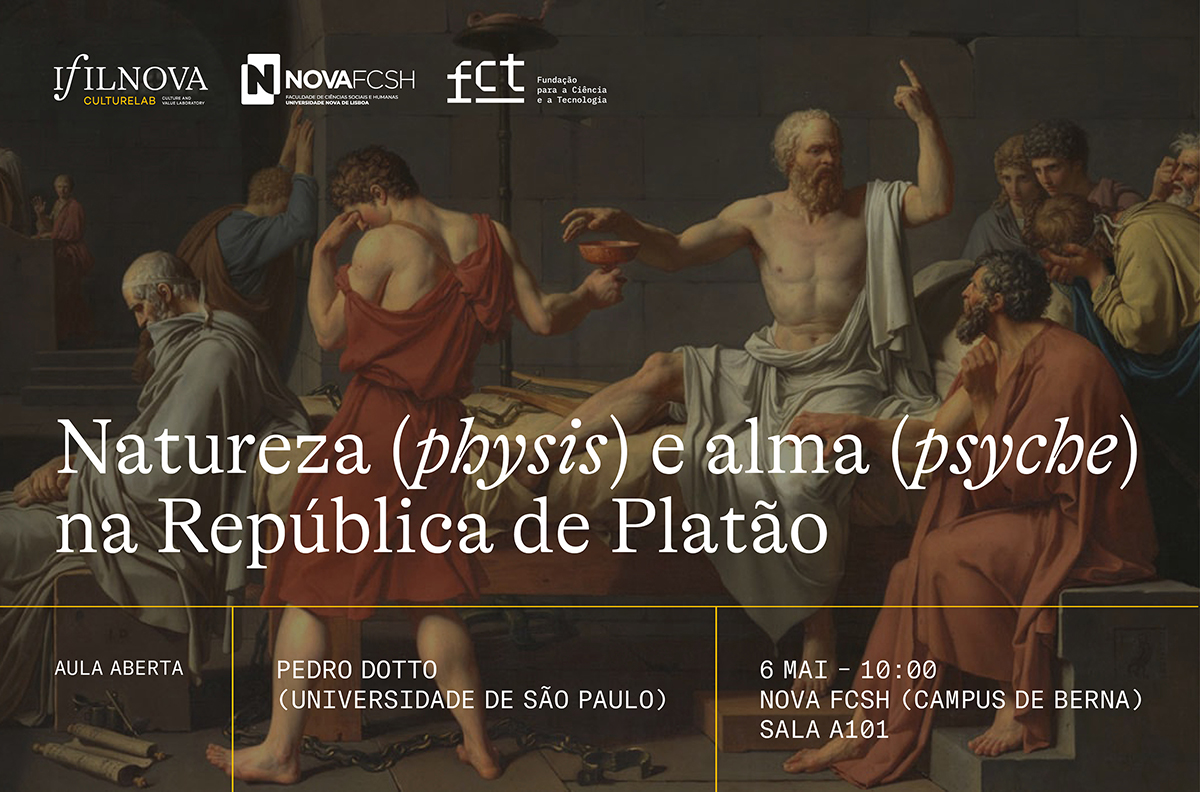
Pedro Dotto (University of São Paulo) will give a Public Lecture at NOVA FCSH, entitled “Nature (physis) and soul (psychē) in Plato’s Republic”, on 6 May 2026, in room A101 (Berna Campus, Tower A), from 10:00 to 12:00. The session will be conducted in Portuguese and will take place as part of the course Philosophy of Nature.
Abstract
In Plato’s Republic, the examination of the soul (psychē) and the discussion of the moral psychology of agents proves inseparable from a rigorous understanding of nature (physis) through a kind of bifocal lens, that is, nature taken as constitutive endowment and nature as consummate realization; in other words, nature as given and as goal. Plato explores this dual articulation of nature through the tripartite structure of the soul, whose elements possess distinct natural functions that establish, simultaneously, both the portrait of how the soul is ordinarily organized and the normative ideal according to which it ought to be arranged. If the psychic parts of an agent cooperate and function in harmony according to their characteristic functions, under the governance of the rational part (λογιστικόν), then there is unification and the tripartite soul approaches a simple and virtuous unity, that is, the agent becomes one from a multiplicity (ἕνα γενόμενον ἐκ πολλῶν, Rep. IV.443e1). On the other hand, if they fail in the orchestration and ordering of their psychic parts, both agential cohesion and moral excellence would be irreparably compromised.
Bio
Pedro M. G. Dotto holds a PhD in Philosophy from The New School for Social Research (NSSR, 2023) and a MA in Philosophy from the Pontifical Catholic University of São Paulo (PUC-SP, 2016). He is currently a postdoctoral researcher at the University of São Paulo (USP), in the Department of Classical and Vernacular Letters (DLCV) of the Faculty of Philosophy, Letters and Human Sciences (FFLCH), funded by a scholarship from the São Paulo Research Foundation (FAPESP). From 15 April to 14 August 2026, he will be at the University of Bonn conducting a research stay (RIA; FAPESP process 2025/20985-9) under the supervision of Prof. Christoph Horn.