

Partition of the soul and moral psychology in Plato
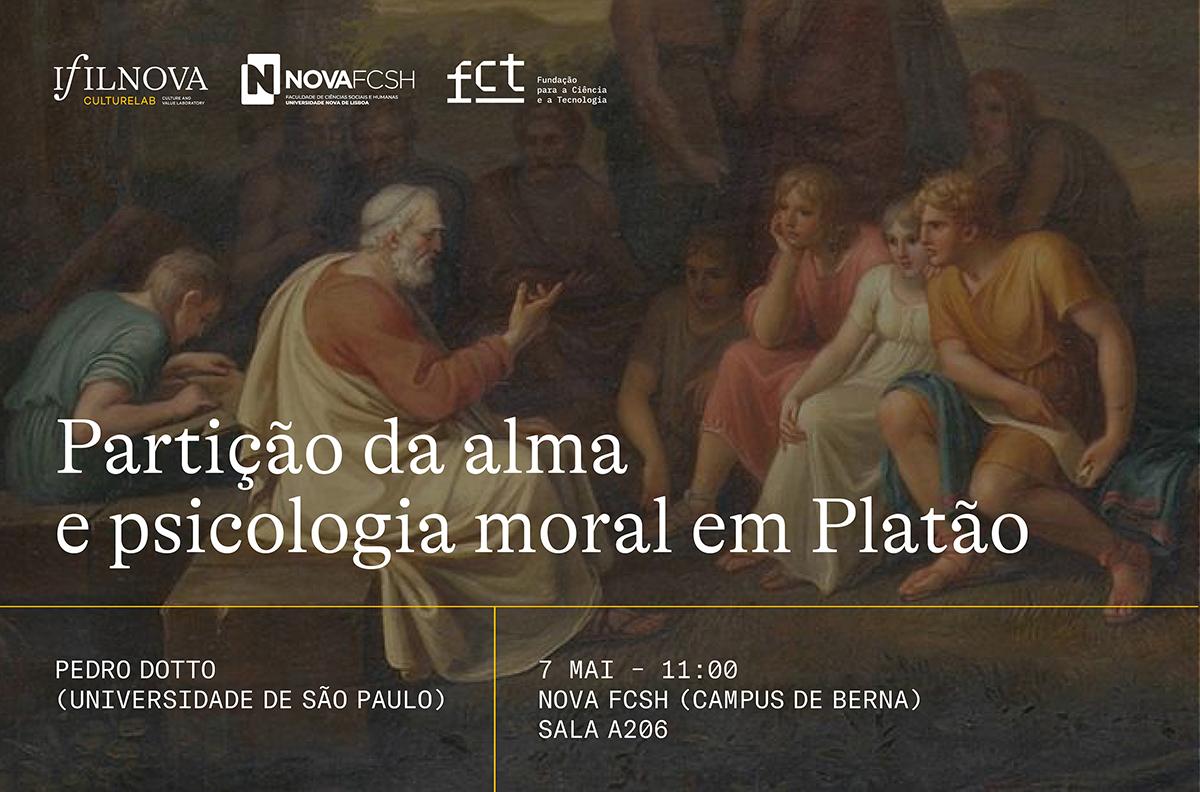
Pedro Dotto (University of São Paulo) will give seminar on “Partition of the soul and moral psychology in Plato”, on 7 May 2026, in room A206 at NOVA FCSH (Berna Campus, Tower A), from 11:00 to 13:00. The session will be conducted in Portuguese.
Abstract
What does it mean to partition the psychē? What kind of division does Plato have in view when he presents the structure of a tripartite soul, with three interdependent elements, and what are the implications of this division of the soul for our understanding of human agency and moral life? These questions touch the core of Plato’s mature-period psychology, from dialogues such as the Republic, the Phaedrus, and the Timaeus. In this lecture, we will explore the motivations underlying Plato’s division of the soul, both its ambitions and its limitations, as well as the different interpretive lines to account for its innovative philosophical proposal. In conclusion, we will seek to defend a deflationary interpretation of the problem of the Platonic psychē‘s partition and of the personification of the psychic parts.
Bio
Pedro M. G. Dotto holds a PhD in Philosophy from The New School for Social Research (NSSR, 2023) and a MA in Philosophy from the Pontifical Catholic University of São Paulo (PUC-SP, 2016). He is currently a postdoctoral researcher at the University of São Paulo (USP), in the Department of Classical and Vernacular Letters (DLCV) of the Faculty of Philosophy, Letters and Human Sciences (FFLCH), funded by a scholarship from the São Paulo Research Foundation (FAPESP). From 15 April to 14 August 2026, he will be at the University of Bonn conducting a research stay (RIA; FAPESP process 2025/20985-9) under the supervision of Prof. Christoph Horn.