

Translation and cosmopolitics. Tensions and deviations in the construction of the common
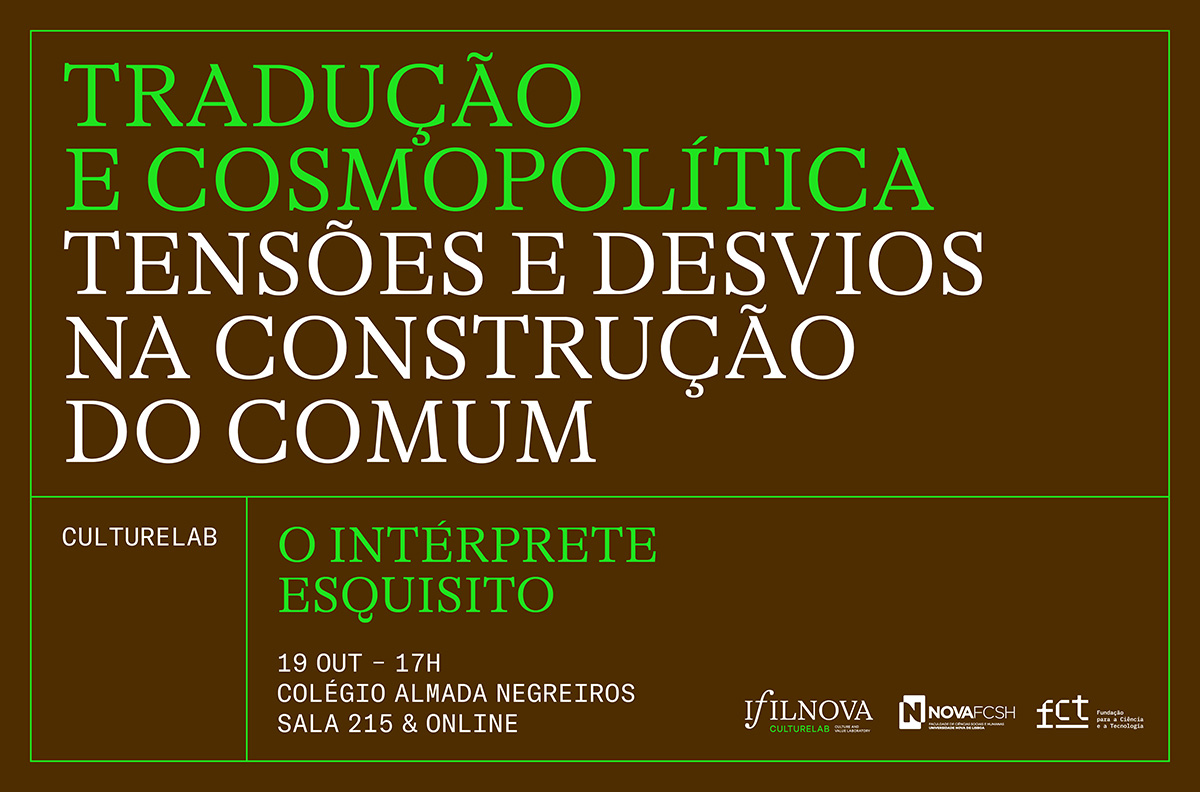
SESSION 2 | THE EERIE INTERPRETER
Monday, 19 October
17h–20h (30-minute break at 18h30)
Colégio Almada Negreiros, Room 215 & Online
To join the session on Google Meet, please get in touch with Laila Algaves Nuñez (lanunez@fcsh.unl.pt).
READINGS
Fisher, M. (2025). “Abordar o Inquietante” e “Algo onde não devia haver nada, nada onde devia haver algo: Daphne Du Maurier e Christopher Priest”. In: O esquisito e o inquietante. VS Editor, pp. 79-93.
Despret, V. (2022). “Autobiografia de um polvo ou a Comunidade dos Ulisses”. In Autobiografia de um polvo e outras narrativas de antecipação. Bazar do Tempo, pp. 81-147.
GUIDING QUESTIONS
Who—or what—can act as an interlocutory agent in the process of translation? What kind of strangeness emerges in encounters with that which resists interpretation? What does fiction make it possible to say or represent that “factual” description cannot? Is translation always, to some extent, an act of fabulation?
About the Reading Group
Organisation: Constanza Solórzano, Laila Algaves Nuñez and Mariana Varela Câmara (IFILNOVA).
This study group investigates translation as a device for negotiating boundaries and as a world-making gesture, one that is decisive in the construction and sharing of aesthetic regimes, a multispecies democracy, and perhaps even the earthly surface itself. In each session, texts will be brought together that inspire a double movement: on the one hand, they open the discussion through key concepts related to this theme—such as hospitality, cosmopolitics, and the very definition of facts in scientific practice; on the other hand, they provisionally ground it in concrete situations in which translational practice becomes necessary: a socio-onto-legal conflict over the protection of caribou in Quebec, a fictional tale that stages the writing of an octopus, and the (once again highly relevant) images of the Moon.
Registration is available via this form.
Participation is free and open to anyone interested in the topics under discussion. There is no need to be a student or to have any affiliation with NOVA FCSH. All sessions will take place at Colégio Almada Negreiros, Lisbon.
Although it is possible to attend individual sessions and/or join the meetings online, priority is given to in-person participation and to the formation of a group that remains together throughout all three sessions, allowing the discussions to develop continuously and to deepen collectively and cumulatively.
All reading materials will be made available to registered participants via a shared Google Drive folder on 14 August, one month before the first session.
More information available in Portuguese.