

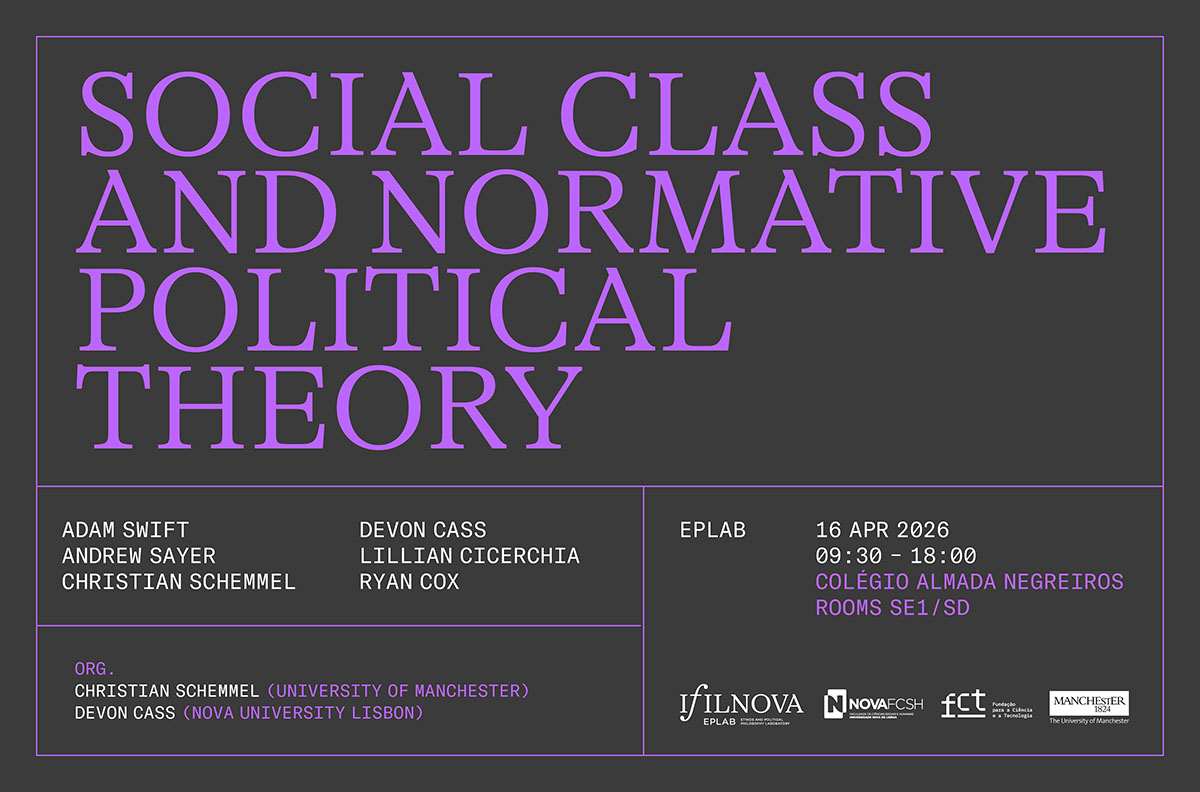
Social Class and Normative Political Theory
IFILNOVA
Lisbon, 16 April 2026
Organisation: Christian Schemmel (University of Manchester) & Devon Cass (NOVA University Lisbon)
Social class inequality used to be a very prominent subject for political theories of justice and equality, with fruitful exchange between sociological research into class and normative theories. While this is still the case within (neo-)Marxism, other sociological approaches to social class, such as Bourdieusian ones, have received much less attention in contemporary theories of justice and equality. These might continue to mention social class, but nowadays often focus more on inequalities connected to other social characteristics and markers, such as gender, ethnicity, race, or sexual orientation. This is the case, too, for the nascent body of theories often grouped under the label “relational (or social) egalitarianism”.
This workshop is dedicated to discussing the normative relevance of social class, drawing on a plurality of different sociological and normative approaches, including, but not restricted to, (neo-)Marxist approaches. Questions for the workshop include:
- What is social class? Is there one overarching concept of social class that adherents of different approaches to theorising class can agree on? If so, how does it relate to experiences of social class, which will be intertwined with, and might often be mediated by, other characteristics of the individual in question?
- How does social class membership and inequality shape and condition social actors’ agency and autonomy, both objectively and subjectively – relating to actors’ perceptions of their options and opportunities, and their self-evaluative attitudes (self-respect/-esteem/-confidence)?
- What, if anything, is distinctively unjust about class inequality? Is the injustice of class inequality, at bottom, about distributive inequality, and if so, inequality of what — income and wealth, education, objectively valuable capabilities? Is there anything normatively special about distributive inequality due to class? Or is it centrally about unjustly unequal relations, and if so, which kind — exploitation, domination, marginalisation, social status inequality? Or is it misguided to want to distinguish sharply between distributive and relational inequalities, in the case of social class?
Programme
Colégio Almada Negreiros
Room SE1 (morning) + Room SD (afternoon)
9:30 Welcome
9:45–10:45 Adam Swift (University College London), “Social Class, Social Mobility and Distributive Justice”
10:45–11:45 Andrew Sayer (Lancaster), “Class: A Moral Economic Perspective”
Coffee break
12:00–13:00 Lillian Cicerchia (Amsterdam), “Can Liberals Take Class Seriously?”
Lunch
14:30–15:30 Ryan Cox (Sydney), “Social Class and Social Hierarchy”
15:30–16:30 Devon Cass (NOVA University Lisbon), “Children’s Independence, Status, and the Case of Social Class”
Coffee break
16:45–17:45 Christian Schemmel (Manchester), “Class Habitus, Equality and Autonomy”
17:45–18:00 Concluding observations/remarks