

Sotera Fornaro & Christian Wollek
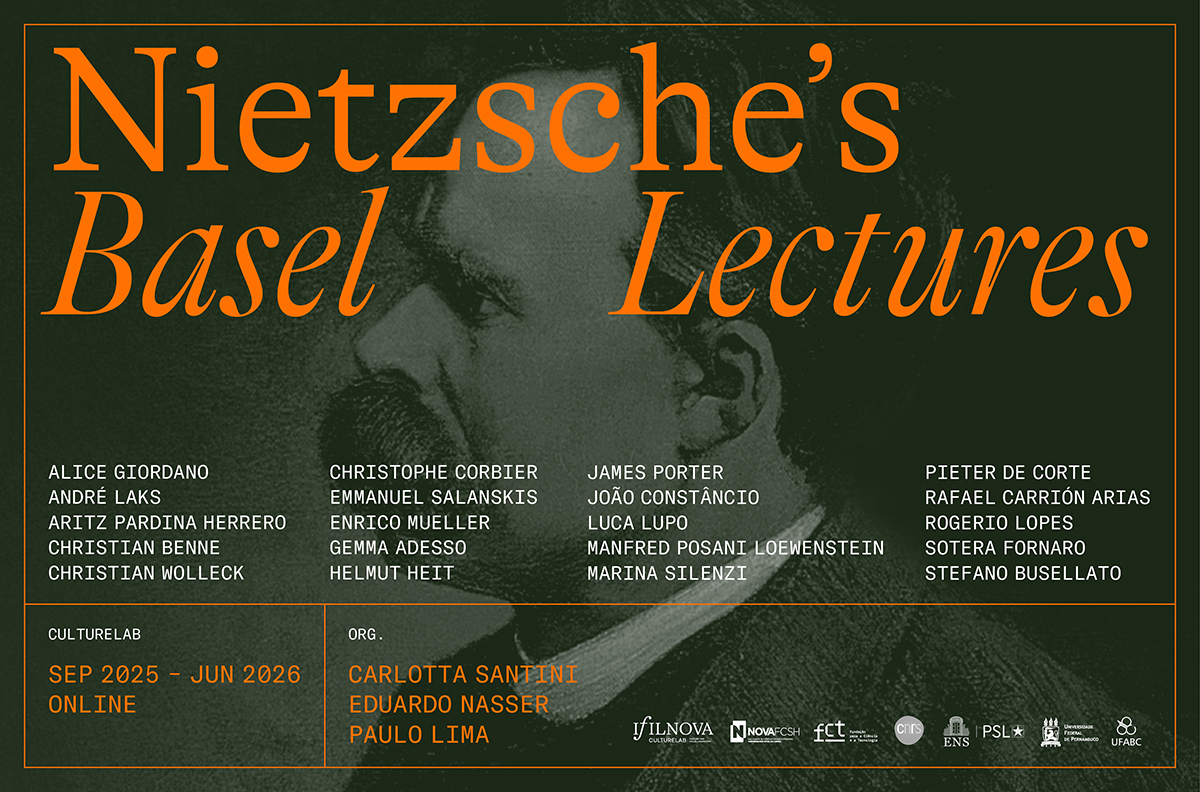
The ninth session of the International Seminar Nietzsche’s Basel Lectures will take place online on 13 May 2026 (Wednesday), from 16:00 to 18:00 (UTC+1). The session will be led by Sotera Fornaro, with a presentation entitled “Emotions and Books: Emotions in Friedrich Nietzsche’s Lectures on Literature”, and Christian Wollek, who will speak on “Nietzsche’s lecture on Latin grammar”.
To join the session, please get in touch with Paulo Lima at plima@fcsh.unl.pt for the details.
Emotions and Books: Emotions in Friedrich Nietzsche’s Lectures on Literature
Abstract: My paper will begin with some general reflections on Nietzsche’s Vorlesungen, asking whether they belong to a specific genre and whether such a genre still exists today. More specifically, I will ask how someone engaged in the same profession as Nietzsche — namely, a professor of Classical Philology — approaches his lectures today, what kind of interest one may find in reading and commenting on them, whether they can still be considered useful, and for what purpose. I will therefore examine the emotional relationship established between the specialist reader of Greek literature and Nietzsche’s lectures (as, more generally, with the lectures of philologists of the past, whether distant or recent). Emotions in fact play a fundamental role in the analysis of this genre, because these texts are, naturally, imperfect writings: notes that were not intended for publication, and in which we are compelled to reconstruct imaginatively the man who once delivered them before an audience of students. We are led to imagine the setting of their performance, the reactions of the audience, and above all the oral additions and developments that Nietzsche himself may have provided beyond his written notes. Within this emotional relationship, the subjective experience of the scholar and teacher of Classical Philology — such as myself — is of considerable importance, since even today I find myself discussing in the classroom many of the very same subjects addressed by Nietzsche. In reading these lectures, I have sought the objects of my own scholarly interests, namely emotions and the emotional dimension of Greek texts. In the Vorlesungen, Nietzsche invokes emotions both as a principle guiding literary composition and as one of the very aims of literature itself, and he demonstrates a remarkably varied vocabulary for expressing the concept of “emotion”. In the lectures we naturally find only brief remarks on these issues, especially — and inevitably — in connection with Greek rhetoric, tragedy, and music. Yet there are also significant observations concerning Homeric epic, whose unity is ultimately traced back to an emotional tone. This conclusion is certainly not entirely original to Nietzsche, but it is one that has only begun to receive sustained attention in Homeric scholarship in recent years.
Bio: Sotera Fornaro is a full professor of Greek Language and Literature at the University of Campania. After completing her PhD in Classical Philology (University of Bari) and in Historical Sciences (University of San Marino), she studied and taught in Heidelberg, Basel, Freiburg, Berlin, Lüneburg and Sassari. Her research interests range from Greek literature (from Homer to the Imperial period) to the history of classical studies, the reception of classical mythology — and in particular the myth of Antigone — and German and contemporary literature. She founded the open-access journals Archivi delle emozioni and Visioni del tragico. Tragedy on the 21st-century stage. She is on the editorial board of many other international academic journals and series, such as the renowned Journal Philologus.
Nietzsche’s lecture on Latin grammar
Abstract: Nietzsche’s work as a professor of classical philology was actually devoted to teaching Greek literature. Nevertheless, probably due to the extraordinary nature of his early appointment, he also had to complete other teaching duties — for example, at the Basel Pädagogium, but also in everyday university life, such as a course on Latin grammar. The compulsory nature of the course is evident from the fact that the Latin language as such was not one of Nietzsche’s interests. Given this starting point, it would now be interesting to see what Nietzsche was able to elicit from this subject matter — the Latin essays written by the Pforten student, in which Nietzsche repeatedly managed to combine compulsory school exercises with personal topics, already indicate that something is to be expected here. Pursuing this line of inquiry will be the subject of this lecture.
Bio: Christian Wollek works as a high school teacher and freelance journalist in Wiesbaden and Naumburg/Saale. After studying philosophy, Slavic studies and classical philology, he focused in particular on Nietzsche’s early writings and philology. Academic publications: Die lateinischen Texte des Schülers Nietzsche (The Latin Texts of the Student Nietzsche), Über Nietzsche. Studien, Reime, Aphorismen (On Nietzsche: Studies, Rhymes, Aphorisms), as well as various articles on Nietzsche research and Nietzsche studies. He also works as a small publisher of ancient poetry.
About the seminar
It is now widely accepted among experts on Nietzsche’s work that his Basel lectures are essential to a proper understanding of the development of his thinking. Now that the lectures have been published in the critical edition of the complete works, it is necessary to study their sources and the methods used in them, as well as their philological and philosophical content. Despite this, they remain largely unexplored. While some relevant research has emerged, it has focused mainly on specific lectures. There is therefore still a need for research that covers all the lectures, studies them systematically and in their interrelationships, looking for differences and similarities and seeking to determine to what extent decisive aspects of what distinguishes Nietzsche’s thought are already present in them or not. This seminar aims to be a first contribution to filling this gap. It will consist of ten monthly sessions. Each session will focus on one of the series of lectures and its key topic. And it will feature two speakers. The seminar format, with its discussion among all participants after each presentation, is a fruitful model for a project of this kind. Attendance to each seminar session must be preceded by registration through one of the organisers, who will provide the respective link (carlottasantini@hotmail.it, enasser@uol.com.br, plima@fcsh.unl.pt). For more information, see the full seminar programme below.
Org. Carlotta Santini (CNRS/ENS, Paris), Eduardo Nasser (UFPE/UFABC), Paulo Lima (IFILNOVA/NOVA FCSH)
Next sessions
17 June 2026 (Wednesday), 16:00–18:00 (UTC+1)
Enrico Müller, “Between Cultic Performance, Symbolic Power, and Aesthetic Achievement: Nietzsche on Attic Tragedy”
Rafael Carrión Arias, “History of Greek Literature from 1874-76: The Origins of Genealogical Method in F. Nietzsche”