

The Film-Phil Lisbon Seminars: Isabel Gamero
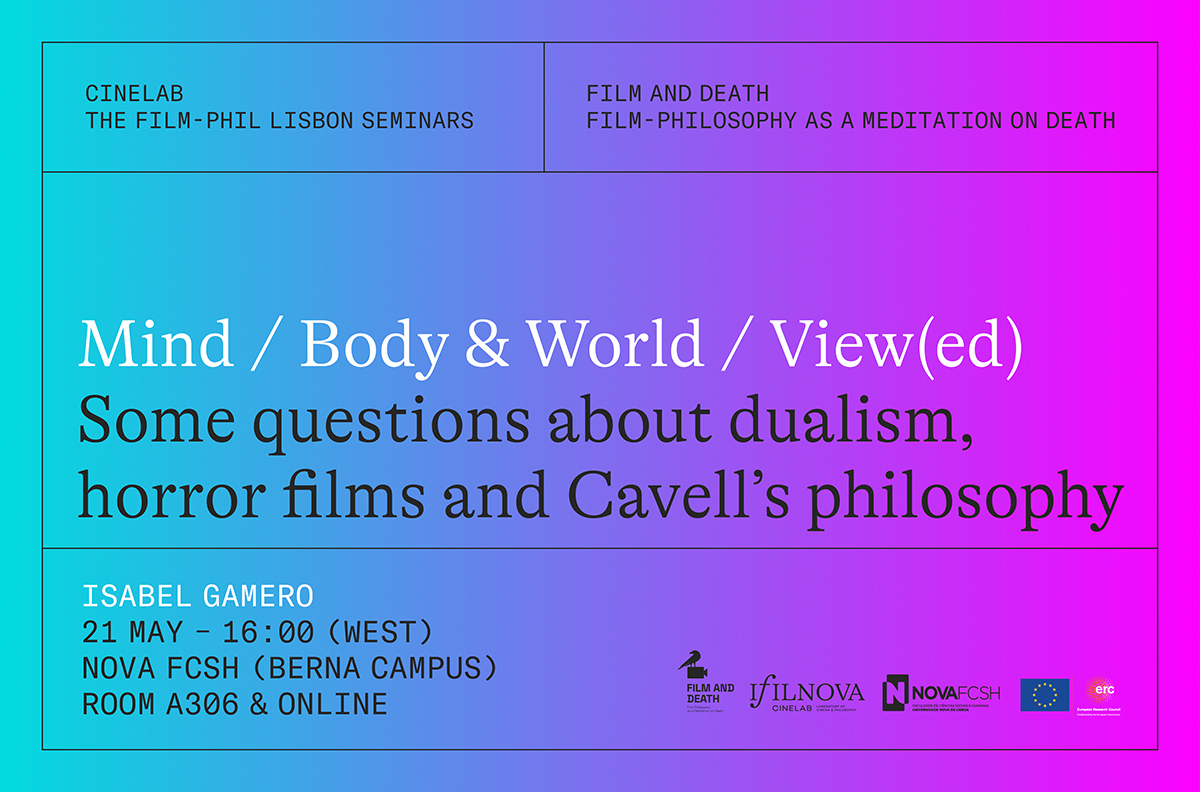
May’s Film-Phil Lisbon Seminar will be led by Isabel Gamero (Complutense University of Madrid) who will talk about “Mind / Body & World / View(ed): Some questions about dualism, horror films and Cavell’s philosophy”. The session will be held on 21 May 2026, at 16:00 (WEST), in room A306 at NOVA FCSH (Av. de Berna, 26 C) & online, via Microsoft Teams. To receive information about joining the meeting online, it’s mandatory to register in advance here.
Abstract
In my presentation I am interested in raising philosophical questions about the peculiar place that horror films occupy within the wider spectrum of film genres. Horror films are generally regarded as a minor genre, aimed more at the immediate thrill of the scare or as the minoritarian taste of viewing of gruesome scenes on the screen. However, there is one clear exception when it comes to classic cult horror films (for example, Murnau’s or Hitchcock’s films), which are really appreciated, especially by critics, and even receive philosophical attention. I wonder whether that different consideration has anything to do with the mind/body dualism, which characterises much of Western thought. To develop my arguments, I will delve into Cavell’s main work about ontology of film, The World Viewed. I will also consider some of the criticism that he has received and will bring examples of contemporary horror films, especially body horror.
Bio
Isabel Gamero Cabrera is Associate Professor at the Philosophy Faculty, Complutense University of Madrid (Spain). Her fields of research are political philosophy, anthropology, feminist philosophy and contemporary epistemology. She has coedited the Bloomsbury Handbook of Wittgensteinian Feminism (2025). She is also passionate about cinema and literature. Her more recent interest is researching the intersections between these disciplines and philosophy. All her publications are available here.