

Sobriety, concreteness and the rewriting of the self in Walter Benjamin’s texts on Moscow
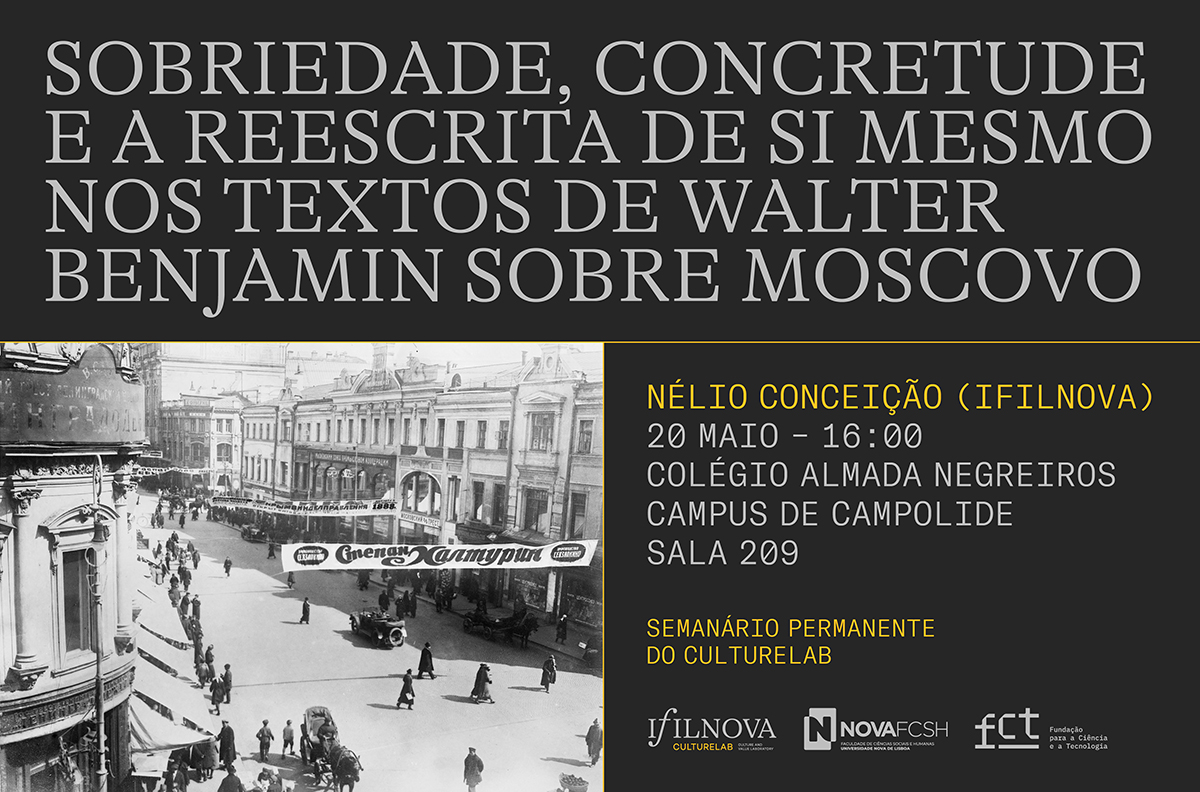
Taking Walter Benjamin’s trip to Moscow between December 1926 and February 1927 as a starting point, my paper aims to analyse how the political, urban and autobiographical dimensions of his thought are inseparable from fundamental metaphysical and aesthetic questions, as well as from an ongoing reflection on language. In the Moscow Diary (27 December 1926), amidst descriptions of his troubled relationship with Asja Lacsis, Walter Benjamin refers to a comment by his host, Bernhard Reich: “he made a very pertinent observation that in great writing the proportion between the total number of sentences and those sentences whose formulation was especially striking and pregnant was about one to thirty — whereas it was more like one to two in my case”. The conversation then shifted toward a philosophical and literary discussion of language, concluding with Reich’s praise for Benjamin’s “essays on cities”, which encouraged him to think about “a presentation of Moscow” — later published in the journal Die Kreatur. Following a brief overview of this conversation and the trip to Moscow itself, my paper will analyse Benjamin’s presentation of Moscow, examining the similarities and differences with the diary and whether it is formulated in a “striking and pregnant” way. While the visit to Moscow had cultural, political and affective relevance for Benjamin, it was also an opportunity to develop broader philosophical questions: i) the concreteness that emerges from attention to detail and to the “creatural”; ii) sobriety as a procedure — in the prologue to Origin of the German Trauerspiel, “prosaic sobriety” is one of the characteristics attributed to philosophical presentation [Darstellung]; iii) the autobiographical aspect and its relation to writing. Taken together, these aspects reveal a mode of thinking which, by revisiting and reworking conceptual frameworks, takes shape through different materialities and contexts.
The seminar will be conducted in Portuguese.