

Varieties of Silencing
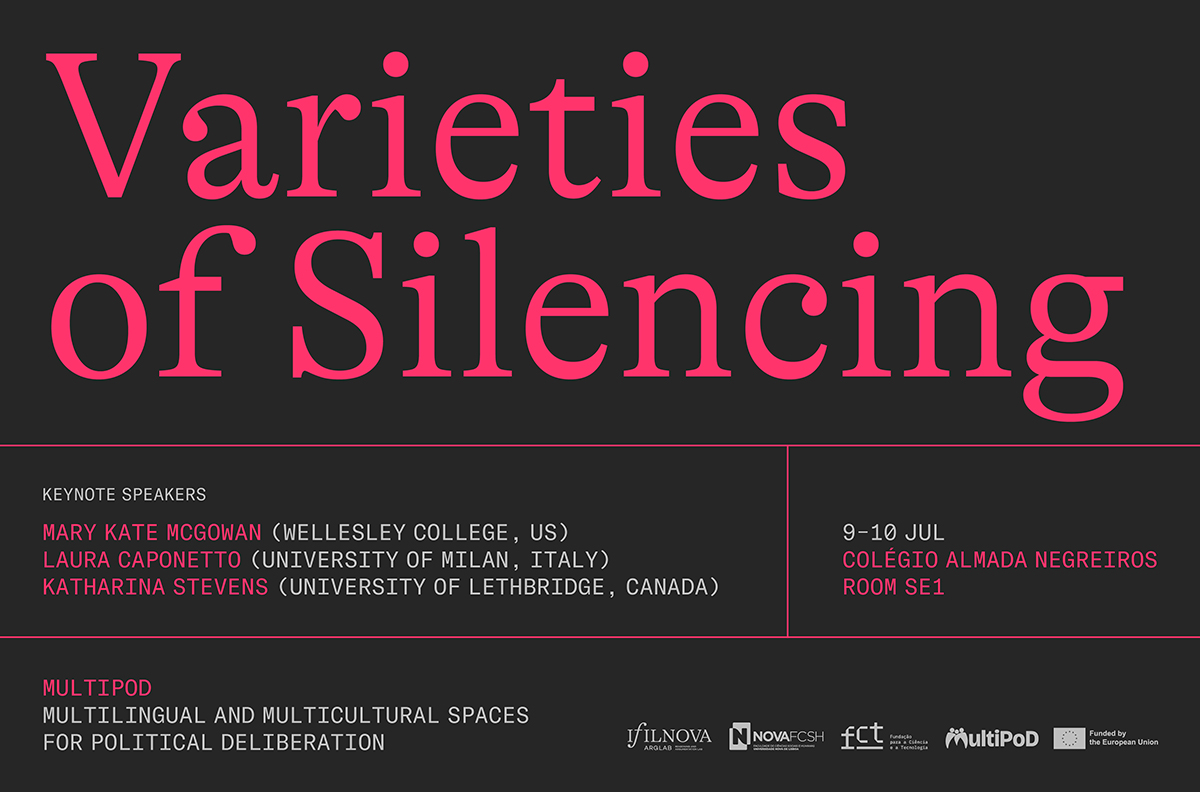
9–10 July 2026
NOVA University Lisbon – Colégio Almada Negreiros, Room SE1
KEYNOTE SPEAKERS
Mary Kate McGowan (Wellesley College, US)
Laura Caponetto (University of Milan, Italy)
Katharina Stevens (University of Lethbridge, Canada)
Equal recognition and inclusive participation are cornerstone principles, and objectives, of the democratic ideal. In our actual societies, however, various social groups, including linguistic and cultural minorities, continue to be excluded from deliberative and decision-making arenas. Underpinning such persistent and systematic exclusions from democratic participation are a variety of causal factors and mechanisms. This workshop focuses on an especially subtle dynamic of exclusion, whereby individuals and groups come to be deprived of their voices, or silenced.
The goal of this workshop is, accordingly, to examine the varieties of silencing. Specifically, it aims to explore 1) the phenomenon of silencing in its multiple forms and from different theoretical perspectives and 2) to illuminate actual manifestations of silencing qua mechanism of democratic exclusion.
Two growing bodies of literature, in particular, speak to the first of these aims. Within the philosophy of language, speech act theory has brought to attention the differences between locutionary silencing (depriving speech of its intended sense and reference), illocutionary silencing (depriving speech of its intended force), and perlocutionary silencing (depriving speech of its intended effects) (Langton 1993; Maitra 2009; Kukla 2014; Caponetto 2021; Medina 2023; McGowan 2026). Within this framework, scholars have examined different mechanisms underlying, mainly, illocutionary silencing—such as misrecognizing the authority, standing, or sincerity of speakers. In turn, argumentation scholars have examined how marginalized groups have been systematically excluded from dominant argumentative practices (Govier 1999; Hundleby 2013). They have also explored the role of fallacious moves such as ad hominem or poisoning the well arguments in silencing others’ argumentative voices (Yap 2013); and how the same moves can, in certain contexts, serve as legitimate tools to overcome certain forms of silencing (Almagro Holgado & Haro Marchal 2025; Stevens 2025). Complementing these discussions, there is growing attention towards the connections between forms of communicative exclusion, such as silencing, and of epistemic exclusion, such as testimonial and hermeneutical injustices.
Alongside such theoretical distinctions and discussions, and speaking to the workshop’s second aim, silencing varies as to its target and context. Important studies have focused on the silencing of women’s voices, specifically, due to the influence of patriarchal conventions and frameworks on the norms of communication (Langton 1993; Maitra 2009; Kukla 2014; Bianchi 2021; McGowan 2026). Others have investigated the silencing of various minorities, from LGBTQI+ movements (Medina 2023) to indigenous communities in Africa and Latin America (Townsend & Townsend Lupin 2020). Further, silencing may be — and has been — examined as it varies across different contexts: from intimate sexual communication to legal proceedings, public consultation and deliberation, to social protest and resistance.
In all, silencing stands out as a phenomenon (or perhaps class of phenomena) of theoretical and practical significance. Accordingly, this workshop brings together work in the philosophy of language, argumentation theory, and social epistemology, with a view to advancing our understanding of how silencing works, and how it affects socially marked groups on a global scale, as well as cultural and linguistic minorities within more localised, national and international contexts.
In view of the forthcoming publication of Mary Kate McGowan’s monograph On Silencing: What It Is and Why It Matters (Oxford University Press, June 2026), the workshop will be a timely opportunity to discuss silencing in all its complexity.
ORGANISING COMMITTEE
Amalia Haro Marchal
Eleonora Volta
Giulia Terzian
Marcin Lewinski
NOVA Institute of Philosophy (IFILNOVA), NOVA University Lisbon, Portugal
Programme
THURSDAY, 9 JULY
9:00–9:30 Welcome
9:30–10:30 KEYNOTE 1: Mary Kate McGowan (Wellesley College, US), On Silencing, Sincerity, and Seriousness
10:30–11:00 Coffee Break
SESSION 1
11:00–11:45 Teresa Marques and Manuel García Carpintero (University of Barcelona, ES), Silenced by the Fantasies that Shape Desire
11:45–12:30 Kyle Adams (University of Waterloo, CA), Deniability, Silencing, and ‘Radical Left Lunatics’
12:30–14:00 Lunch
SESSION 2
14:00–14:45 Yener Çağla Çimendereli (Old Dominion University, US), Muffling and Linguistic Injustice
14:45–15:30 Casey Rebecca Johnson (University of Idaho, US), Illocutionary Relativism and Speakers’ Agency
15:30–16:15 Chris Cousens (University of Manchester, UK), Deadnaming, Silencing, and Subordination
16:15–16:45 Coffee Break
16:45–17:45 KEYNOTE 2: Laura Caponetto (University of Milan, IT), Varieties of Speech Distortions
FRIDAY, 10 JULY
9:30–10:30 KEYNOTE 3: Katharina Stevens (University of Lethbridge, CA), Kind to Be Cruel – Silencing through Charity
10:30–11:00 Coffee Break
SESSION 3
11:00–11:45 Vanessa Franco Ramírez (Institución Universitaria de Envigado, CO; University of Salamanca, ES), Beyond Paper Rights: A Multidimensional Approach to Silencing in Intercultural Argumentation
11:45–12:30 Dima Mohammed (NOVA University Lisbon, PT), Argumentative Potential and the Restructuring of Disagreement Space: Silencing Positions in Public Debate
12:30–14:00 Lunch
SESSION 4
14:00–14:45 Cristina Ganz (University Vita-Salute San Raffaele, IT), Obstetric Violence as Discursive Injustice: The Erosion of Epistemic Agency in Perinatal Care
14:45–15:30 Jimena Zapata (Ludwig-Maximilians Universität München, DE), Attentional Silencing: Collective Non-Response and the Erosion of Shared Awareness
15:30–16:00 Coffee Break
SESSION 5
16:00–16:45 Manuela Teles (NOVA University Lisbon, PT), Silencing Beyond Deficits: Rethinking Conceptual and Performative Approaches across Hermeneutical Injustice and Speech Act Theory
16:45–17:30 Álvaro Domínguez Armas (Charles University, CZ) and André Santos Campos (NOVA University Lisbon, PT), Overcoming Silencing through Argumentative Representation
Download the programme here. Book of abstracts here.
For additional information, visit the workshop website.