

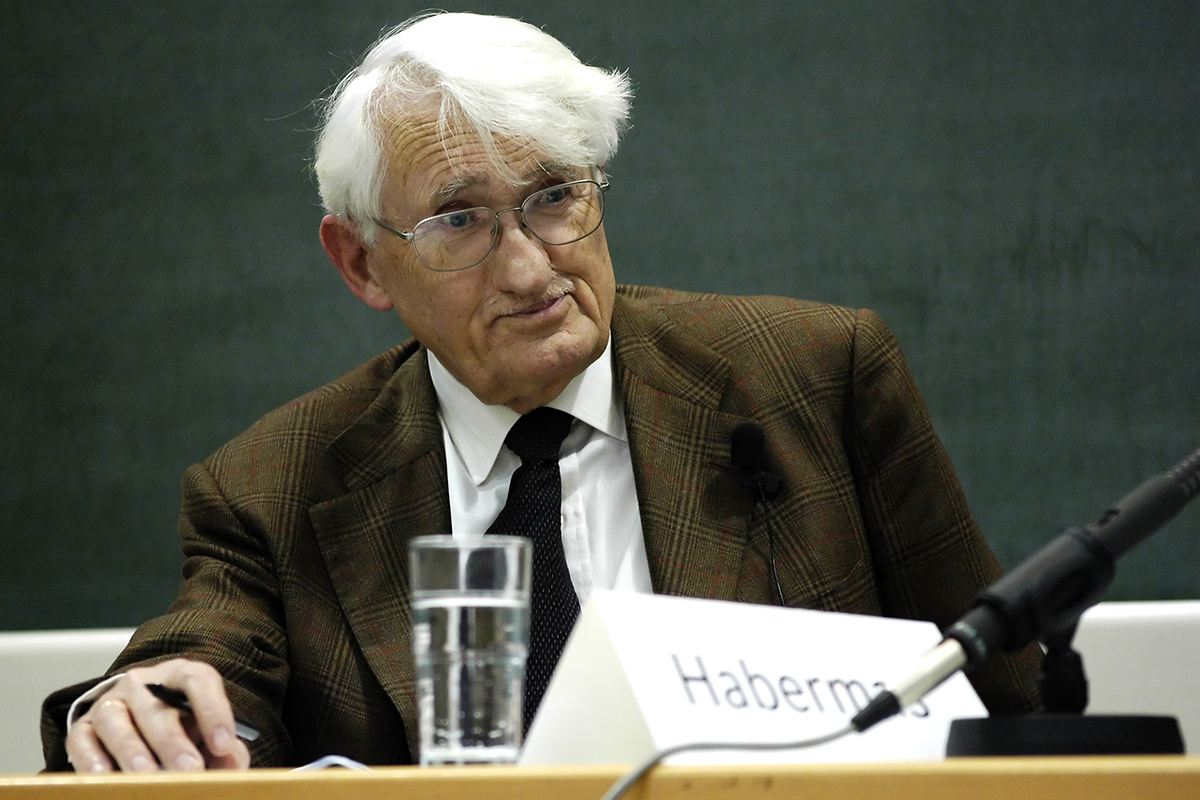
Jürgen Habermas died on 14 March 2026 at the age of 96 in Starnberg, Germany. He was one of the most influential thinkers of our time, and his work spans the philosophy of language, the theory of communicative action, political philosophy, and what he termed discursive ethics. He was widely regarded as one of the last representatives of the European Enlightenment, writing in a world where disruptive global forces increasingly threaten democracy and freedom. In this context, his theory of communication oriented towards mutual understanding remains an important theoretical and practical framework for interpreting both the past and the present. It suggests, ultimately, that another conception of human communication may be possible—one grounded in a more progressive and ethical development.
As a tribute to the philosopher and his work, IFILNOVA expresses its gratitude for the contributions received from a range of researchers — both affiliated with the institute and external — and presents these testimonies below (written in Portuguese, except for the contribution by Regina Queiroz).
O último iluminista europeu? — António Marques (IFILNOVA, Universidade NOVA de Lisboa)
Um incontornável na Filosofia — André Santos Campos (IFILNOVA, Universidade NOVA de Lisboa)
Entre patriotismo constitucional e cosmopolitismo jurídico: Habermas e a modernidade política — Giovanni Damele (IFILNOVA, Universidade NOVA de Lisboa)
Salvaguardar o Lebenswelt com Habermas — Inês Pinheiro (IFILNOVA, Universidade NOVA de Lisboa)
Testemunho — José Lamego (Universidade de Lisboa)
Sovereignty and Human Dignity: The Political Legacy of Jürgen Habermas — Regina Queiroz (Universidade Lusófona)
Habermas e o pensamento pós-metafísico — Sílvia Bento (Universidade do Porto)