

A Perennial Utopia and Its Failure: The Idea of A Universal Republic
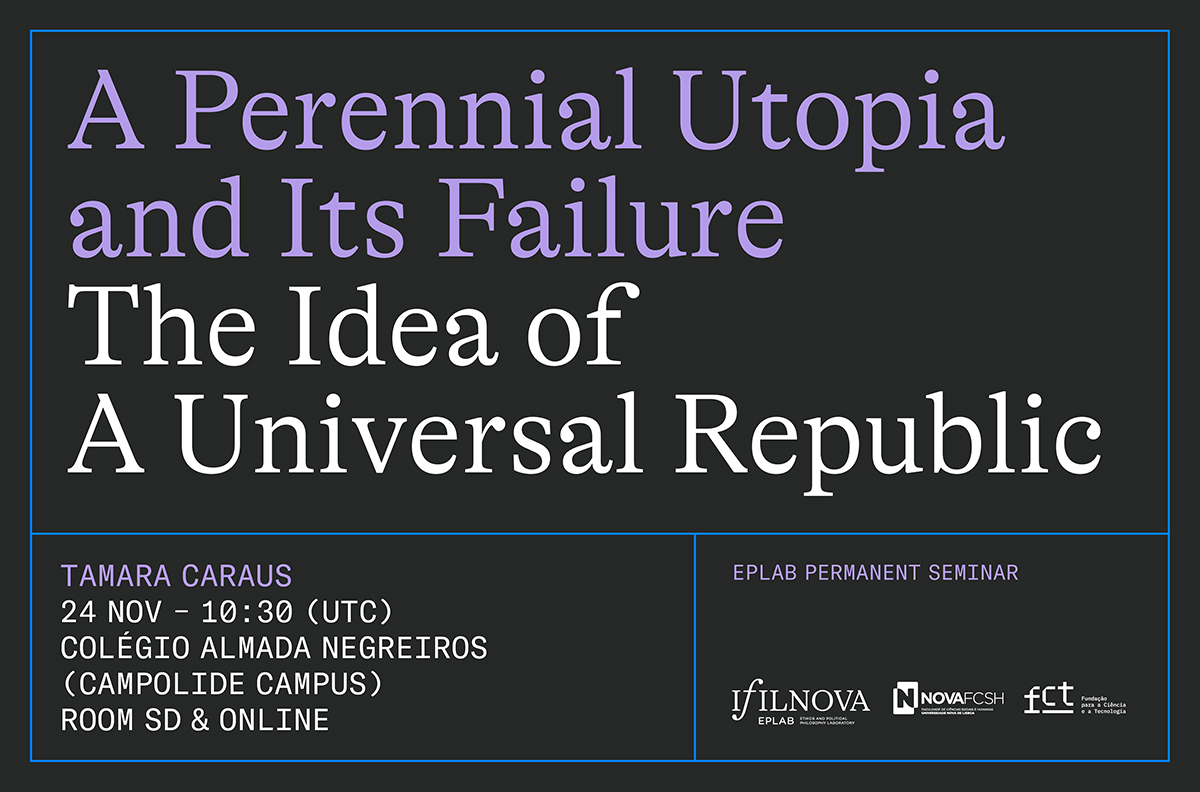
The 15th session of the EPLab Permanent Seminar will be led by Tamara Caraus (U. Lisboa), who will talk about “A Perennial Utopia and Its Failure: The Idea of A Universal Republic”. The session will take place on 24 November, at 10:30, in room SD at Colégio Almada Negreiros (Campolide Campus), with online transmission, and will be held in English.
Anyone interested in attending, either in person or online, should contact the organisers: Inês Pinheiro (ines.pinheiro@campus.fcsh.unl.pt) and Devon Cass (devoncass@fcsh.unl.pt).
Abstract
The idea of a Universal Republic appears as a perennial utopia doomed to fall. Expressed firstly by an early Stoic, Zeno, in his lost Republic, through the image of a ‘herd that feeds together and shares the pasturage of a common field’, the idea of one world and one human community has been restated periodically in different religious and revolutionary contexts. The first two decades after the WWII were the heyday of the actions undertaken by scientists, activists, and ordinary people to implement the idea of a world institution grounded in the idea of peace, and the latest reiteration was made within migrant activism that declared that No One Is Illegal. However, in political philosophy, the idea of a Universal Republic, as a rule, is met with derision and fear, e.g. Hannah Arendt, in The Origins of Totalitarianism, considered those who attempted to think a world institution ‘professional idealists’ with a language of ‘societies for the prevention of cruelty to animals’. Kant himself, fearing of a ‘soulless despotism’, postponed the idea indefinitely, a fear restated by Rawls, credited with the revival of political philosophy in the XX century. Acknowledging the failure, this presentation asks if the idea of a Universal Republic could be thought anew by examining the main criticisms that point to imminent threat to diversity, difference, pluralism, etc. It argues that criticism comes from the presupposition of a consent, unity, and ultimate meaning that, once instituted, cannot but lead to a global Leviathan. The fearful uniformity attributed to the Universal Republic is an extrapolation of the vision of unity and solidarity in a ‘well-ordered’ society, which is the ultimate normative vision of the current political philosophy, achieved through exclusion of the ‘outsiders’ and of the ‘burdened’ societies. By addressing its current structure of exclusion and by acknowledging the past and present interdependencies of the world, political philosophy cannot but arrive at the idea of the Universal Republic, not as embodying an absolute meaning, a set of ultimate certainties or a global consensus, but as the ‘dissolution of the markers of certainty’ (Lefort) both locally and globally. Through permanent questioning, the idea of a Universal Republic could re-emerge as an institution of radical democracy.
Bio
Tamara Caraus is a Principal Investigator at the Centre of Philosophy, University of Lisbon. She contributed with articles to various academic journals and edited volumes, published six books and co-edited six volumes. Her current area of research includes political philosophy, Marx and Critical Theory.
More information on the EPLab Permanent Seminar here.