

André Laks & Helmut Heit
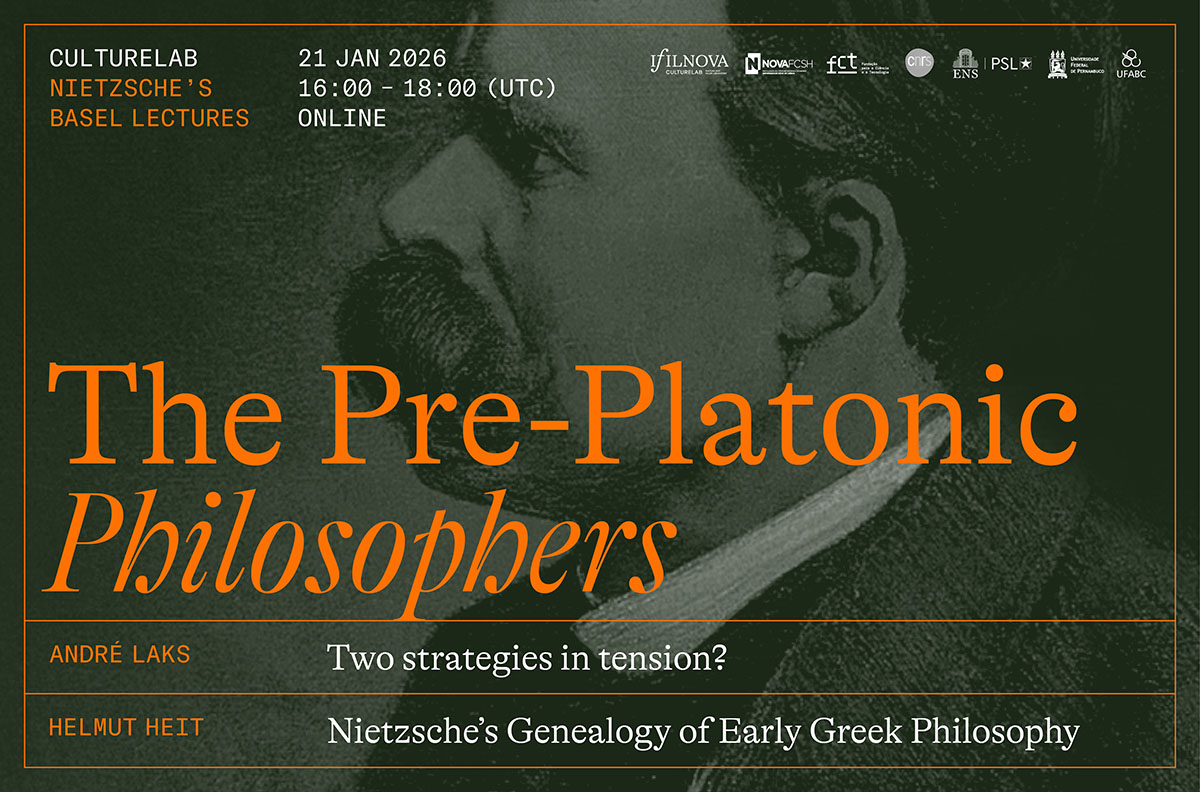
The fifth session of the International Seminar Nietzsche’s Basel Lectures will be dedicated to the theme The Pre-Platonic Philosophers and will take place online on 21 January 2026 (Wednesday), from 16:00 to 18:00 (UTC). The session will be led by André Laks, with a presentation entitled “Two strategies in tension?”, and Helmut Heit, who will speak on “Nietzsche’s Genealogy of Early Greek Philosophy”.
Two strategies in tension?
Abstract: In the wake of The Birth of Tragedy from the Spirit of Music (BT), which had been released in December 1871, Nietzsche worked during the year 1872 on an piece entitled Philosophy in the Tragic Age of the Greeks (PTG) that was meant to be a “counterpart” (Seitenstück) of BT. This is also the period when Nietzsche gave Lectures (Vorlesungen) on The Pre-Platonic Philosophers (PP) at the University for the first time (Summer Semester 1872; he would take them up in SS 1873 and 1876). PTG, which was meant to become a book (letter to Gersdorff, April 5, 1873) was left unfinished, for reasons that it may be interesting to discuss. As I was writing an article on PTG (now in process of publication), I wondered about the relationship (similarities, differences) between PTG and PP, and concluded to the existence of a certain tension between the two. I my presentation, I shall briefly explain why and look forward to the discussion of what to date remains a question.
Bio: André Laks has taught Greek and Ancient Philosophy at the University of Lille, Princeton University, and Paris-Sorbonne before retiring to Mexico, where goes on teaching in the Department of Philosophy at the Universidad Panamericana, Campus Mexico. He is the author, among others, of an Introduction à la ‘philosophie présocratique’ (PUF, 2004), translated into English by Glenn Most under the non-ambiguous title The Concept of Presocratic Philosophy, Its Origin, Development and Significance (Princeton, 2018), and co-author with the same Glenn Most of the nine-volume Loeb Early Greek Philosophy (Harvard, 2016). He has also written on Plato’s political philosophy (Plato’s Second Republic: An Essay on the Laws, Princeton 2022) and on the history of the reception of ancient philosophy (Historiographies de la philosophie ancienne. Neuf études, Les Belles-Lettres, 2021), where there is a short section devoted to Nietzsche and his Philologica.
Nietzsche’s Genealogy of Early Greek Philosophy
Abstract: This presentation develops Nietzsche’s view on a question he himself raised in the first lecture on the Pre-Platonic Philosophers: Why did the Greeks engage in philosophy? By dwelling on his Basel lectures as well as related texts such as the unpublished manuscript on Philosophy in the Tragic Age of Greece, this presentation situates Nietzsche’s approach within the later 19th century context. I try to show that Nietzsche approaches the issue in ways which are in part timely and in part untimely. Among other aspects, Nietzsche’s take on the emergence of philosophy in early Greek antiquity is original, because—unlike the majority of historians of philosophy from Aristotle until today—he considers that very fact as something which is in need of explanation.
Bio: Helmut Heit is head of research and director of the Kolleg Friedrich Nietzsche at the Klassik Stiftung Weimar, and he is an honorary professor of philosophy at the Technical University of Berlin. After studying philosophy and political science in Hanover and Melbourne, he received his philosophical doctorate in 2003 from the University of Hanover with a dissertation on the origins of philosophy in ancient Greece. He subsequently worked in Hanover, San Diego, and Berlin. At the Technical University of Berlin, he conducted research as a Dilthey Fellow on Nietzsche’s philosophy of science and directed the Berlin Nietzsche Colloquium, which he founded, from 2007 to 2013. Research stays took him to the Institute for Advanced Study in Princeton in 2012–13 and to the Universidade Federal de Pelotas (2014–15). From 2015 to 2018, he was Vice Director of the Academy of European Cultures at Tongji University in Shanghai. Since 2017, Helmut Heit has been co-editor of the international journal Nietzsche-Studien and the book-series Monographien und Texte der Nietzscheforschung (de Gruyter). Helmut Heit is interested in the Western tradition, its Greek origins, its theoretical optimism, and its practical crises. His work focuses primarily on cultural, scientific, and social philosophy, Nietzsche, and critical theory.
Some of his publications are:
- Der Ursprungsmythos der Vernunft. Zur philosophiehistorischen Genealogie des griechischen Wunders (Würzburg, 2007)
- Frühgriechische Philosophie (Stuttgart, 2011)
- Nietzsche as a Scholar of Antiquity (ed. with Anthony Jensen, London 2014)
- Paul Feyerabend: Philosophy of Nature (ed. with Eric Oberheim, Cambridge 2016)
- Nietzsche und die Reformation (ed. with Andreas Urs Sommer, Berlin 2020)
- Fortgesetzte Identitätskrise: Der Westen im Spiegel Chinas (in: Kursbuch 211, 2022).
About the seminar
It is now widely accepted among experts on Nietzsche’s work that his Basel lectures are essential to a proper understanding of the development of his thinking. Now that the lectures have been published in the critical edition of the complete works, it is necessary to study their sources and the methods used in them, as well as their philological and philosophical content. Despite this, they remain largely unexplored. While some relevant research has emerged, it has focused mainly on specific lectures. There is therefore still a need for research that covers all the lectures, studies them systematically and in their interrelationships, looking for differences and similarities and seeking to determine to what extent decisive aspects of what distinguishes Nietzsche’s thought are already present in them or not. This seminar aims to be a first contribution to filling this gap. It will consist of ten monthly sessions. Each session will focus on one of the series of lectures and its key topic. And it will feature two speakers. The seminar format, with its discussion among all participants after each presentation, is a fruitful model for a project of this kind. Attendance to each seminar session must be preceded by registration through one of the organisers, who will provide the respective link (carlottasantini@hotmail.it, enasser@uol.com.br, plima@fcsh.unl.pt). For more information, see the full seminar programme below.
Org. Carlotta Santini (CNRS/ENS, Paris), Eduardo Nasser (UFPE/UFABC), Paulo Lima (IFILNOVA/NOVA FCSH)
Next sessions
18 February 2026 (Wednesday), 16:00–18:00 (UTC)
João Constâncio, “Nietzsche on Plato’s Phaedrus and the Question of Writing”
Pieter De Corte, “Nietzsche on Plato’s Political Thought in the Basel Lectures”
18 March 2026 (Wednesday), 16:00–18:00 (UTC)
Luca Lupo, “Saying Yes: The Doctrine of Assent”
Stefano Busellato, TBD
15 April 2026 (Wednesday), 16:00–18:00 (UTC+1)
Rogerio Lopes, “Much Ado About (Almost) Nothing: How to Avoid Philosophical Inflation of Genealogical Claims”
Aritz Pardina Herrero, “F. Nietzsche’s Rhetoric Lectures: Dating and Interrelationship (and Why These Are Important)”
13 May 2026 (Wednesday), 16:00–18:00 (UTC+1)
Sotera Fornaro, TBD
Enrico Mueller, TBD
17 June 2026 (Wednesday), 16:00–18:00 (UTC+1)
Gemma Adesso, “The Art of Reading and Writing”
Rafael Carrión Arias, “History of Greek Literature from 1874-76: The Origins of Genealogical Method in F. Nietzsche”