

Christian Wollek & Marina Silenzi
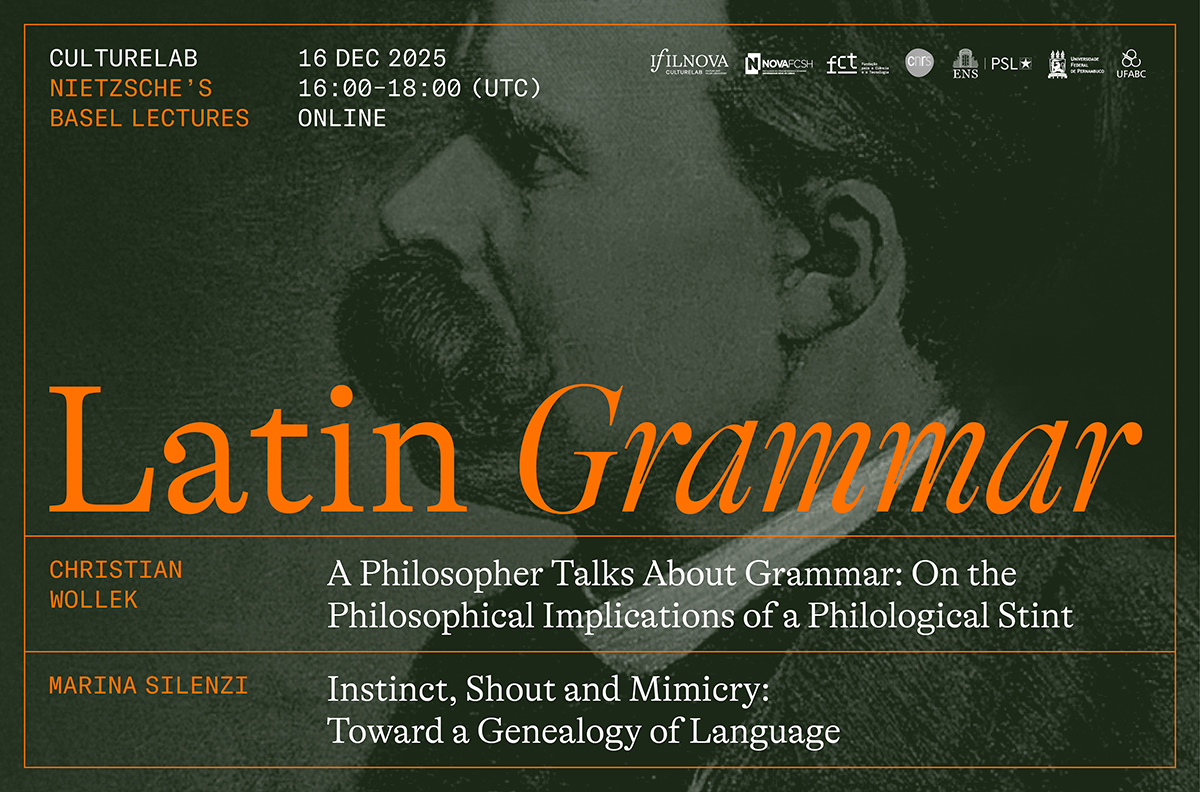
The fourth session of the International Seminar Nietzsche’s Basel Lectures will be dedicated to the theme Latin Grammar and will take place online on 16 December 2025 (exceptionally on Tuesday), from 16:00 to 18:00 (UTC). The session will be led by Christian Wollek, with a presentation entitled “A Philosopher Talks About Grammar: On the Philosophical Implications of a Philological Stint”, and Marina Silenzi, who will speak on “Instinct, Shout and Mimicry: Toward a Genealogy of Language”.
A Philosopher Talks About Grammar: On the Philosophical Implications of a Philological Stint
Abstract: Nietzsche’s work as a professor of classical philology was actually devoted to teaching Greek literature. Nevertheless, probably due to the extraordinary nature of his early appointment, he also had to complete other teaching duties – for example, at the Basel Pädagogium, but also in everyday university life, such as a course on Latin grammar. The compulsory nature of the course is evident from the fact that the Latin language as such was not one of Nietzsche’s interests. Given this starting point, it would now be interesting to see what Nietzsche was able to elicit from this subject matter—the Latin essays written by the Pforten student, in which Nietzsche repeatedly managed to combine compulsory school exercises with personal topics, already indicate that something is to be expected here. Pursuing this line of inquiry will be the subject of this lecture.
Bio: Christian Wollek works as a high school teacher and freelance journalist in Wiesbaden and Naumburg/Saale. After studying philosophy, Slavic studies and classical philology, he focused in particular on Nietzsche’s early writings and philology. Academic publications: Die lateinischen Texte des Schülers Nietzsche (The Latin Texts of the Student Nietzsche), Über Nietzsche. Studien, Reime, Aphorismen (On Nietzsche: Studies, Rhymes, Aphorisms), as well as various articles on Nietzsche research and Nietzsche studies. He also works as a small publisher of ancient poetry.
Instinct, Shout and Mimicry: Toward a Genealogy of Language
This presentation reconstructs Nietzsche’s early theory of the origin of language (1869-1872), taking as a starting point his Basel Lectures on Latin Grammar, particularly chapter I, Ursprung der Sprache. Hartmann holds in his work that instinctive forms of expression are insufficient for communication, as only their translation into thoughts and words renders them intelligible. Nietzsche, drawing on Hartmann’s view of instincts as foundational and his insights into the unconscious, develops a divergent account: for him, the affective and instinctual dimension is not a preliminary deficiency but the core of linguistic emergence.
Nietzsche situates rhythm (Urmelodie, a primordial articulation of Lust and Unlust), at the center of language. Rhythm forms the earliest shared expression of the Naturmensch, whose embodied reactions, tonal modulations, and gestures (Gebärden) create a dynamic unity. Meaning emerges not from representing inner states but through transduction, converting affective tensions into rhythmically structured tone and gesture, which ground later symbolic.
I further argue that these tonal and gestural expressions arise within socially and physiologically organized communities: the “organized mass”. Drawing a parallel between this process and the experience of tragedy, I suggest that aesthetic and ritualized practices illuminate the genealogy of language: just as tragedy integrates affect, rhythm, and movement, early communicative forms emerge from embodied, social, and rhythmic experience, laying the groundwork for articulated speech.
Bio: Marina Silenzi studied philosophy with a focus on aesthetics and discourse theory and critique in Argentina. She conducted research stays in Vienna and Berlin with scholarships from the ÖAD and DAAD. She earned her doctorate from the University of Basel in 2020, supported by a Swiss National Excellence Scholarship, with a monograph later published by De Gruyter: Krankheit und Gesundheit in der späten Philosophie Friedrich Nietzsches. She is the author of numerous publications on Nietzsche, art and the body, as well as on the philosophy of Judith Butler. She currently works as an associated researcher and lecturer at the University of Basel.
About the seminar
It is now widely accepted among experts on Nietzsche’s work that his Basel lectures are essential to a proper understanding of the development of his thinking. Now that the lectures have been published in the critical edition of the complete works, it is necessary to study their sources and the methods used in them, as well as their philological and philosophical content. Despite this, they remain largely unexplored. While some relevant research has emerged, it has focused mainly on specific lectures. There is therefore still a need for research that covers all the lectures, studies them systematically and in their interrelationships, looking for differences and similarities and seeking to determine to what extent decisive aspects of what distinguishes Nietzsche’s thought are already present in them or not. This seminar aims to be a first contribution to filling this gap. It will consist of ten monthly sessions. Each session will focus on one of the series of lectures and its key topic. And it will feature two speakers. The seminar format, with its discussion among all participants after each presentation, is a fruitful model for a project of this kind. Attendance to each seminar session must be preceded by registration through one of the organisers, who will provide the respective link (carlottasantini@hotmail.it, enasser@uol.com.br, plima@fcsh.unl.pt). For more information, see the full seminar programme below.
Org. Carlotta Santini (CNRS/ENS, Paris), Eduardo Nasser (UFPE/UFABC), Paulo Lima (IFILNOVA/NOVA FCSH)
Next sessions
Session 5: The Pre-Platonic Philosophers
21 January 2026 (Wednesday), 16:00–18:00 (UTC)
André Laks, “Two strategies in tension?”
Helmut Heit, “The Pre-Platonic Philosophers”
18 February 2026 (Wednesday), 16:00–18:00 (UTC)
João Constâncio, “Nietzsche on Plato’s Phaedrus and the Question of Writing”
Pieter De Corte, “Nietzsche on Plato’s Political Thought in the Basel Lectures”
18 March 2026 (Wednesday), 16:00–18:00 (UTC)
Luca Lupo, “Saying Yes: The Doctrine of Assent”
Stefano Busellato, TBD
15 April 2026 (Wednesday), 16:00–18:00 (UTC+1)
Rogerio Lopes, “Much Ado About (Almost) Nothing: How to Avoid Philosophical Inflation of Genealogical Claims”
Aritz Pardina Herrero, “F. Nietzsche’s Rhetoric Lectures: Dating and Interrelationship (and Why These Are Important)”
13 May 2026 (Wednesday), 16:00–18:00 (UTC+1)
Sotera Fornaro, TBD
Enrico Mueller, TBD
17 June 2026 (Wednesday), 16:00–18:00 (UTC+1)
Gemma Adesso, “The Art of Reading and Writing”
Rafael Carrión Arias, “History of Greek Literature from 1874-76: The Origins of Genealogical Method in F. Nietzsche”