

Nietzsche on Culture
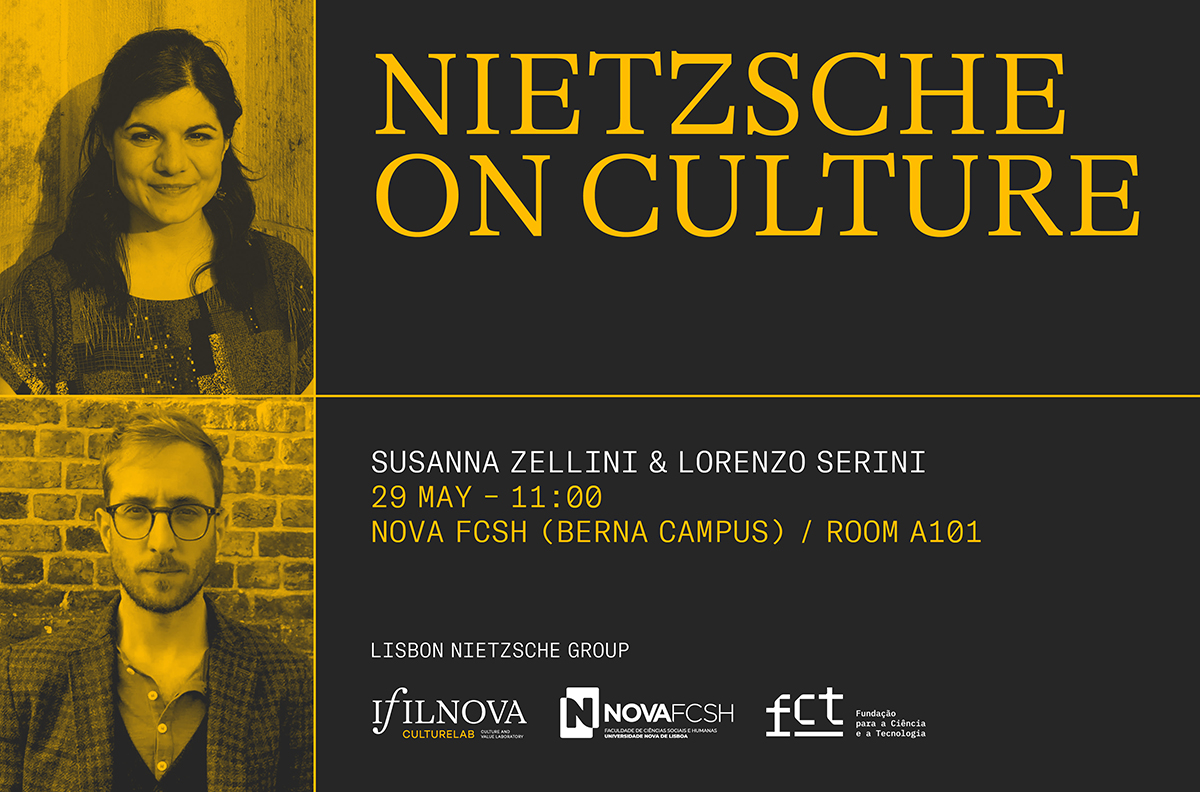
Susanna Zellini, “Nietzsche on Culture and the University”
When Friedrich Nietzsche writes the lectures “On the Future of Our Educational Institutions”, he still belongs to the academic world and believes that a form of resistance to the culture of the university can still be pursued from within. This position generates a deep tension between the prevailing academic culture and its rejection, between false (“Pseudokultur” or “Halbbildung”) and true culture, and between distorted and authentic forms of freedom. While, on a personal level, this tension leads to his definitive departure from the university, on a philosophical level it opens up the space for a radically new reflection on academic freedom, understood through the relationship between solitude and academic community. This paper investigates the genesis of these themes through a confrontation with Ralph Waldo Emerson (in particular “The American Scholar”) and Arthur Schopenhauer (“On University Philosophy”), tracing their roots within a broader tradition of reflection on the idea of the university, from Wilhelm von Humboldt to Friedrich Schiller and Friedrich Schleiermacher, in the context of the project for the reform of the German university. On this basis, the paper asks whether the university can still function as an “institution of culture”, what the “cultural value” of the university is, and on which concepts of freedom and autonomy such a role could rest. More specifically, it examines whether an authentic philosophy (eigentliche Philosophie) can still find an academic dwelling, or whether it necessarily requires a form of withdrawal from the institution. While Nietzsche’s diagnosis appears largely negative, his early writings already identify the conditions for rethinking the relationship between philosophy and the university.
BIO | Susanna Zellini is an FNRS Assistant Professor at the Université catholique de Louvain, an MSCA Fellow at the Centre Prospéro in Brussels, and an associated researcher at the Centre Marc Bloch. She is co-coordinator of the Seminario Permanente Nietzscheano (SPN) and a member of the Centro Italiano di Studi Nietzscheani (CISN) of HyperNietzsche, as well as of the Internationale Nietzscheforschungsgruppe Stuttgart (INFG). Her research focuses on the history of the concept of Bildung in nineteenth- and twentieth-century German philosophy and on its relevance for contemporary debates on education. Among her recent publications is “Ästhetik der Form. Sprachkritik, Musik und Stil bei Nietzsche und Adorno” (De Gruyter, 2024). She is currently preparing the publication of Wilhelm von Humboldt, “Teoria della Bildung” (Italian translation and scholarly edition, Melangolo, 2026).
Lorenzo Serini, “Nietzsche on Slave Morality, the Emotions, and the Transformation of Culture”
In key works such as “Human, All Too Human”, “Beyond Good and Evil”, and “On the Genealogy of Morals”, Nietzsche develops the distinction between master and slave morality as part of his broader account of processes of cultural formation and transformation, including the creation of values. In this presentation, I examine the role of emotions in this distinction. I suggest that approaching the distinction between slave and master morality through the lens of the emotions offers a productive way of complicating Nietzsche’s account of cultural transformation. I focus in particular on Nietzsche’s characterisation of slave morality, seeking to clarify his use of the vocabulary of ‘slavery’ in this context. On this basis, I interrogate what I call his ‘necessity claim about slavery’, according to which “slavery in some sense or other” is needed for the enhancement or elevation of culture (BGE 257). Finally, I assess whether Nietzsche’s position on these issues is ultimately defensible or salutary.
BIO | Lorenzo Serini is Assistant Professor in the Department of Philosophy at the University of Warwick. His areas of specialization include post-Kantian European philosophy (especially Nietzsche), the history of western philosophy (both ancient and modern), virtue/vice epistemology, and philosophy of emotions. He recently published “Nietzsche’s Conception of Skepticism as Intellectual Virtue and Vice” in the European Journal of Philosophy. He is currently co-editing a volume for Palgrave, titled “The Metaphor of Slavery in the Philosophy of Emotions: A History and Critique”.